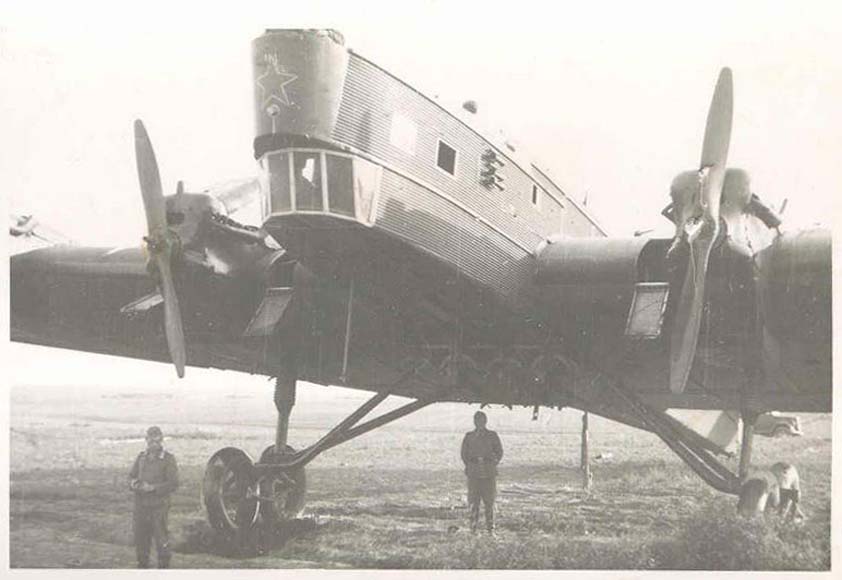
| Tupolev TB-3 The Beloved Behemoth
|
Is there
a more stately, charming or just plain interesting aircraft than
Tupolev's ANT-6 design? For the author, it's hard to think of one. But,
for all of this admiration, what do we really know of this somewhat
early design, its versions and its finish in military service? Any
attempt to understand the TB-3 is a bit of a journey into the unknown.
It was made and placed into service during a period which is not
especially well documented nor understood. Thereafter it soldiered for
a very long time, some examples more than decade after they were built.
The photographic record of the type is poor, and what we do have is a
confusing assortment of mostly German film types.
This article-- to appear in several parts-- will attempt to address
some of these questions. Some better-- and lesser-- known examples will
be analysed and presented in profile. From these studies, perhaps we
can advance our knowledge of this wonderful giant, and re-visit some
very old and by now tired assumptions about the appearance of these
wonderfully improbable aerial contraptions...
Part 2
In 1933, series manufacture of the new Mikulin M-34 engine began
and this power-plant was immediately installed on examples of the
ANT-6. The M-34 was a direct-drive 12 cylinder motor of 800 hp (750 hp
sustained maximum) with a number of innovative features, and proved to
be exceptionally reliable in service. This ruggedness made it ideal for
long-range aviation, and thus the ANT-6 was an obvious target for its
use. The first recipients of the M-34 were indeed civilian ANT-6
models, followed by a number of Aeroflot G-2 machines [these to be featured in upcoming parts of this article], but soon enough military versions of the TB-3 were also built with the new engine.
The initial TB-3 M-34s were in fact nothing more than directly
re-engined models, similar in all other details to late M-17F powered
versions. However, along with a switch to the geared M-34RNA motor a
re-design of the aircraft's fuselage was undertaken, and these changes
subsequently implemented into series production. The fuselage was
lengthened by just under a metre, projecting aft of the rudder and thus
providing space for a gunner's position in the tail (with the
characteristic cut-out in the lower rudder shape). The two dorsal
gunner's positions were replace by a single, wider, station, this with
the capacity to mount an MV or SV-17 turret if desired. The older
double-bogey wheels were soon replaced by a larger single tyre,
additionally, and there were numerous changes in radio fitment and
their associated antennae. By the time of the FRNA equipped models the
nose had been redesigned with an SV-17 turret replacing the open
position, and the very last military TB-3s were
powered by the 1200 hp M-34FRNV.
The modifications carried out on service TB-3s by regiments in the
field are legion. Many aircraft of the 250 and 325 APs ADD were fitted with two
MV-3 turrets in the dorsal gunner's positions, and one example was seen
with a TAT turret from a Pe-8. ShKAS guns usually replaced DAs by the
start of the war, and a few fittings of UBT weapons were seen in the
dorsal position of later FRNV models. Additional external racks
for munitions or supplies were not at all unusual; door modifications
for the dropping of paratroops; vehicle carriers; additional navigation
equipment, and in fact a host of other specialised items could be
seen. TB-3s served robustly into the war years despite their aged and
somewhat obsolete design.
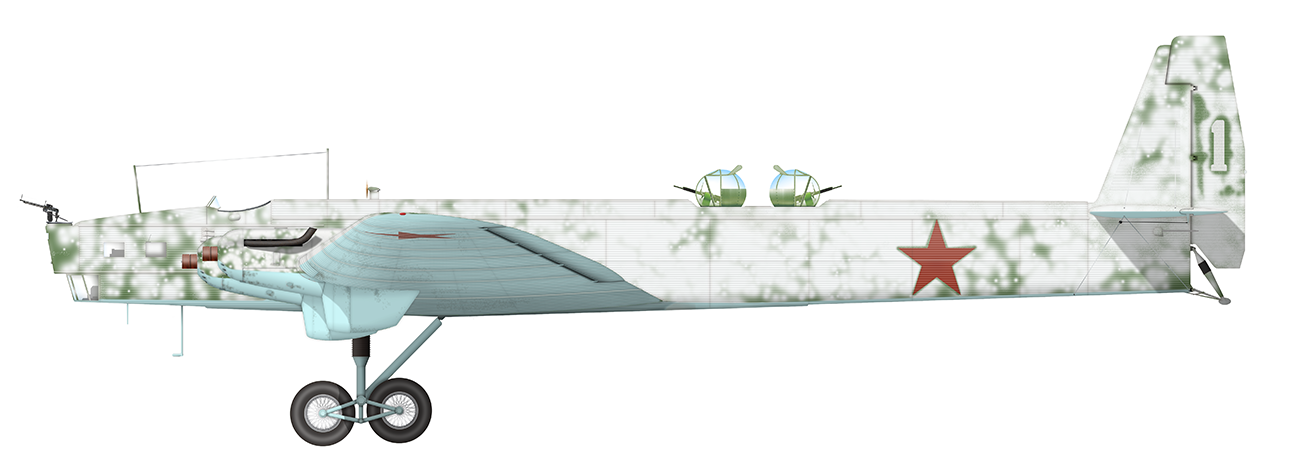
TB-3 4M-34 "White 1" 1 Aviapolk ADD

This rather fetching TB-3 M-34 was in service with the 1 AP of the ADD
in early 1942 (later to become the 1 Guards AP). MK-7 White was applied
heavily over the upper surfaces of this aircraft as was the custom for
the first winter of the war. Two MV-3 turrets were installed on this
example identically as seen more famously in other regiments [see
below]. Care was taken to paint around the original national star on
the fuselage as well as the tactical number on the rudder, and one
presumes that both markings were original to the aircraft when
completed.
TB-3 4M-34 "Red 1" 325 Aviapolk ADD
This TB-3 has been quite often confused with a rather similarly
camouflaged TB-3 M-17F of the 250 AP ADD, also "Red 1". However, that
machine was older, powered by the M-17, and its base paint coat was the
dark olive scheme as seen on such models [see Part 1]. This example
"Red 1" was powered by the M-34 and was seen in service with the 325 AP
in Moscow. It has always been mooted that the installation of these MV
turrets was completed at Factory No 39, and while quite logical the
author has yet to see that idea confirmed by any primary source. That
the work was carried out in and around Moscow, however, seems to be
correct, as this modification only appears on TB-3s of units serving
near the capital (such as the 1, 250, 325 AP, etc).

Twin MV-3 turret installation on an M-17 powered TB-3 of the 250 AP.
Broad areas of applique black colour were added in this case, as
opposed to the more detailed and complex pattern seen on "Red 1" of the
250 AP. The base finish was of 3B over (perhaps) AEh-4, as suitable for
the time of its manufacture. The fusalge star marking was modified with
a thin black outline of the immeditaely pre-war style, but looks to
have been original besides that, whereas the numeral on the rudder was
a darker red colour and almost certainly applied with AII paints.

TB-3 4M-34FRNA "Red 2"
At least six TB-3s were ordered by the Chinese government during
1937, and of these three are shown in a very short clip of 16 mm cine
film on an unknown airfield. The following image, which admittedly
leaves much to be desired, is a still taken from that roll. However
poor, careful examination of this image just
shows the re-painted area on the fuselage where the Russian star
marking had been obliterated, and possibly a similar area on the fin. A
small number "2" is also just visible on the aft fuselage, and it would
appear to have been red in colour.

The wing under-surface of one example is seen later in the clip, and
this view demonstrates Chinese national markings under the wing; one
wonders if similar insignia had been applied to the upper surfaces? The
rudder was finished with classic Chinese striping, and this feature was
seen on the elevator surfaces additionally. The aircraft seemed to have
been lacking any radio equipment and their associated antennae.

TB-3 4M-34FRNA "Red 5"
"Red 5" was a rather typical example of a later model TB-3 in VVS
service at the outbreak of war. The finish was the original factory
applied single-colour upper surface livery with national star, and a
darker numeral on the rudder added subsequently. This machine was said
to be operational with the 1 TBAP during the autumn of 1941.

TB-3 4M-34FRNA "White 1"
The reference image below shows a line-up of operational TB-3s during
the war, but the date of the photograph is not agreed across several
sources. Two of these captions give a very late reference to 1944 and
1945, respectively, and if correct surely by these dates such aircraft
would be engaged in training or other similar second-line roles.

All of the machines in view demonstrate different radio fitment, as one
might indeed expect to see on aircraft so long in service. Our subject
here, "White 1", was fitted with an interesting and somewhat unusual
D/F loop under the nose, much more commonly seen on civil model ANT-6s.
A disruptive camouflage pattern has been added to the original finish,
and the choice of black lacquer used cannot be known. The national star
insignia have been embellished with mid-war style white outlines, and
while the large tactical number on the fin looks to be fairly worn
there is a more freshly applied trim added above this in white. The
stabiliser bracing wires have been fitted with these thin light metal
sheet covers of the type which invariably go quickly missing in combat
operations, perhaps reinforcing the idea that these examples enjoyed a
more docile life in training duties?

TB-3 4M-M34RNA "Red 3" 14 Aviapolk ADD
"Red 3" was a somewhat rare interim model TB-3 featuring the new
extended fusealge but retaining the original open nose. Power in this
version was provided by the M-34RNA and the armament usually consisted
of twin DA mounts in all positions as shown here. At least one RNA
model was seen mounting an SV-17 turret dorsally, but most did not.

This photograph purports to show TB-3 p/n 220528, which seems plausible
given the details in view. The finish was a quite typical 3B/AEh-4
scheme of the time, to include a national star marking in the older
Army Red colour. The numeral looks to be a darker red, no doubt AII
paints once again.

TB-3 4M-34FRNV "White 4" 3 Aviapolk ADD
There are different captions for the photo showing "White 4"
depending upon the printed source, and the author is uncertain as to
which might be correct. The main contention is the date of the
photograph (unit assignment is agreed), with one source giving a
pre-war date of 1940 and the second a wartime date in late 1941.

Whichever may be the case, the finish is certainly original, as built,
with a 3B/AEh-4 scheme and old red star. A number of TB-3s shown in
pre-war images show various tactical stripes, and "White 4" does so as
well, these being somewhat worn looking and applied to the aft fuselage
and wings (upper and lower surfaces). The aircraft was fitted with a
twin ShKAS mount in the dorsal position and carried a single FAB 2000
bomb under the fuselage.
Next installement: ANT-6 civil models...
----------------------------
