Tupolev TB-3  The Beloved Behemoth

Updated Dec 2022

Is there a more stately, charming or just plain interesting aircraft than Tupolev's ANT-6 design? For the author, it's hard to think of one. But, for all of this admiration, what do we really know of this somewhat early design, its versions and its finish in military service? Any attempt to understand the TB-3 is a bit of a journey into the unknown. It was made and placed into service during a period which is not especially well documented nor understood. Thereafter it soldiered for a very long time, some examples more than decade after they were built. The photographic record of the type is poor, and what we do have is a confusing assortment of mostly German film types.

This article-- to appear in several parts-- will attempt to address some of these questions. Some better-- and lesser-- known examples will be analysed and presented in profile. From these studies, perhaps we can advance our knowledge of this wonderful giant, and re-visit some very old and by now tired assumptions about the appearance of these wonderfully improbable aerial contraptions...


The Military TB-3

While the Army Air Force (VVS) was scarcely interested in such 'trivial' minutia, the Tupolev Design Bureau went to very great lengths to differentiate the civil and military versions of their ANT-6 design. Models were of course delivered to the military as heavy bombers (Tyazheliy Bombardirovchik, thus 'TB-'), but these were but a tiny fraction of the many civilian uses which Tupolev had in mind for his four-engined machine. Indeed, he had hoped to receive orders for, and to build, many such variants: to carry passengers, heavy cargo, post and other communications duties, for long range exploration and mapping, for emergency and rescue duties, meteorological work, medical services and hospital transportation and record breaking flights, to name but a few. All of these models were adamantly referred to by the Bureau as ANT-6 aircraft, and indeed it worth recollection that it was three such civil machines which Tupolev dispatched to the Paris Air Salon in 1934 (URSS-2237, -2238, -2239), not military versions.

Whatever Tupolev's ultimate plans, however, it was of course the development of the Army's TB-3 which primarily drove the main programme. The aircraft was placed into series production and military service, both, during 1932, and examples were built at two factories-- No 22 at Fili (Moscow) and No 39 at Khodinka (Moscow). Tupolev's Bureau was based primarily at Fili [1] which previously had been the Junkers facility in Moscow (the so-called "Junkers Concession"), and the resulting TB-3 was very obviously a Junkers inspired design, with a thick aerofoil, corrugated dural skinning and an all-metal Junkers method framework construction. Being the Soviet aviation industry, of course, the two plants did not build identical versions of the TB-3, and as always Factory No 39 considered itself to be an elite facility and its models to be the more advanced. It is certainly true that most of the experimental development of the TB-3 took place here, even if the Tupolev Bureau was officially at Fili.

In addition to the various physical differences between the factories' aircraft, this Junkers plant pedigree was related to the TB-3's subsequent appearance and finish as well. Before being taken over by Junkers AG, the site was an automotive factory [2], and when the German firm established manufacture there it found copious stocks of car and lorry paint and none of aviation lacquer, much to its considerable displeasure. It is documented that Junkers-Fili imported German aviation finishes for use at the factory from its Dessau HQ, and that these were subsequently employed in the production of its local products such as the Ju-20, Ju-21, JuG-1 and so forth. A number of photographs exist showing these machines sitting next to examples of the R-3 (ANT-3) built at the same plant during
Junkers' stewardship of the factory, and their appearance (in terms of colouration and finish) is identical. One must conclude that these R-3 aircraft were surely painted with German aviation finishes.

From later in 1927, the first Tupolev designs built after the end of Junkers' operation of the facility such as the I-4 (ANT-5) and TB-1 (ANT-4) were also seen wearing finishes precisely like those of the aforementioned Junkers models, and similarly so proven by appearinmg in photos depicting both types adjacent to each other. The most logical conclusion must be that indeed they were painted with remaining stocks of German lacquers. Although not absolutely proven by period documentation, it seems very unlikely that Soviet industry produced any indigenous Butyrate or other enamel aero lacquers at the time (preferred for use on metal surfaces), all of the known species of finish being cellulose varnishes. The desire to use up these stocks of paint would be obvious, and indeed it is not beyond reason that additional quantities of these more suitable finishes could have been subsequently ordered if necessary. Moreover, it is also reasonable to presume that the local staff at Fili would have preferred to continue using the same methods and techniques as when working for Junkers AG, if possible.

All of which brings us neatly to the TB-3. Photographs exist showing early TB-3s sitting next to Air Force TB-1s (e.g. not civil nor G-1 models), and they are identical to the earlier aircraft in finish and colouration. Could it therefore be, five years on from Tupolev supplanting Junkers at Fili, that the factory was still using German aviation lacquers on series built all-metal aircraft? It's an intriguing possibility, and not the kind of result one might expect, to say the very least. But, having said that, the evidence in this matter is not limited to monochromatic photography; and hence our first example for analysis.

TB-3 4M-17F "Red 1"

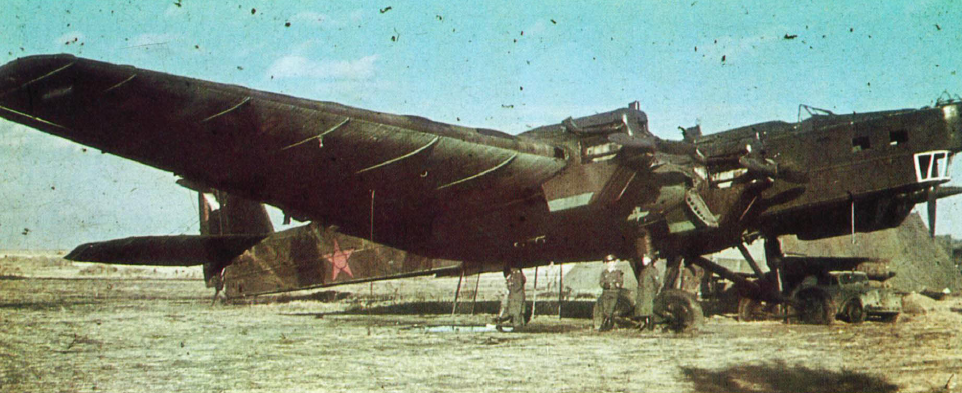
This TB-3, likely an early M-17F powered model, was built at Factory No 22 and photographed by German personnel during the autumn of 1941. The image was taken on AGFA Neucolor stock (sub-version unknown). The aircraft's orignal finish was still intact as evidenced by the period
'Circle-Star' type national marking still in its older Army Red colour (which predated the use of AII Red for that purpose). The lower colour demarcation was very much of the 'Germanic' style, complete with these odd 'stripe' features on the lower cowlings. Areas of the airframe had been subsequently 'embellished' with applique black colour, to possibly include the landing gear struts. Of remarkable note is the internal colouration in view on the wing leading edge fold-out step which bears an exceptionally uncanny resemblance to RLM 02 Grey (as would have been applied by Junkers, for example).


It is the author's opinion that the paints in view (obviously notwithstanding the applique colour, stars and number) cannot be of Russian origin-- they simply do not look like any known Soviet aviation lacquer. For a start, the sheen is by far too matte for any known indigenous finish, and the colouration appears to be equally unprecedented (even comparing to Factory No 1's khaki finish), both upper and lower surfaces. Of course, it is true to say that the exact original appearance of these shades cannot be determined from this photo-- an important caveat to apply here-- but over-all the 'look-and-feel' just seems to be German, not Russian. Every detail seems to fit this pattern, even the propellers. These have been painted, and is the colour seen above 'black' or is it Schwarzgrun, as on Luftwaffe machines?

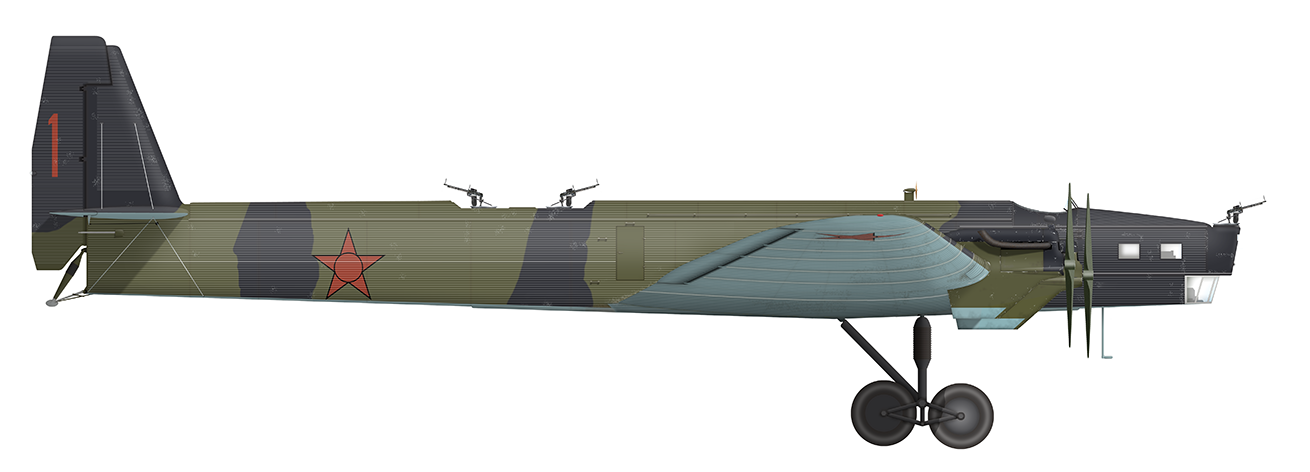
Assuming that this interpretation is correct, "Red 1's" appearance might be similar to the following profile.


TB-3 4M-17 no number p/n 3901

If the hypothesis is true that early aircraft built at Factory No 22 were indeed finished with German aviation paints, then we should expect that contemporary examples built at Factory 39-- with no legacy of German ownership-- would be finished differently. Interestingly, this difference in colouration and finish is exactly what we find in the photographic record.

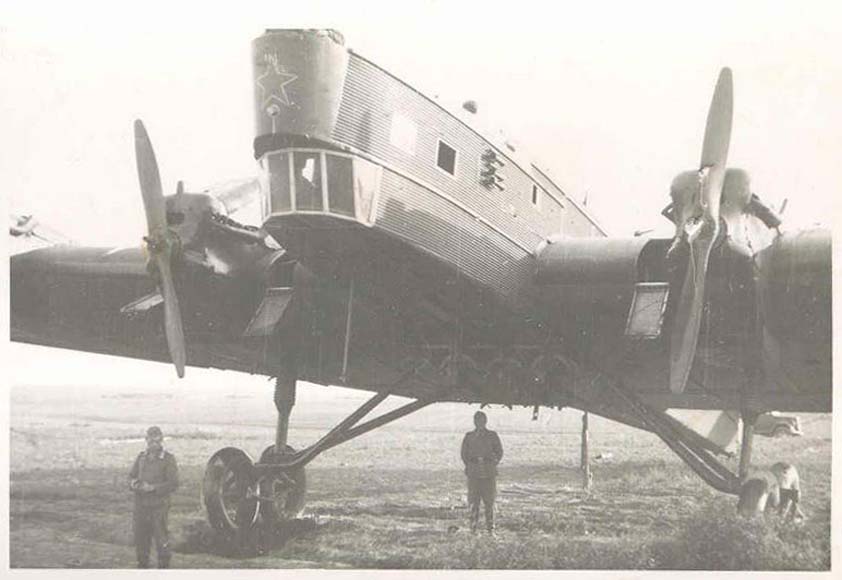
P/N 3901 was the first TB-3 manufactured at Khodinka early in 1932. This machine lacks the bombardier's pannier under the nose as on most Factory No 39 examples, as well as multitude of small detail differences to later models, and is fitted with two 'dust-bin' style defensive turrets under the wing centre sections. This photograph is not particularly good [better images of this aircraft are known, however], but even so one may see clearly that it is not painted identically to "Red 1" (see above), or other contemporary Fili built TB-3s. The upper surface colour is not nearly as dark, neither the lower, the surface sheen is greater (approximately satin, or thereabouts), the colour demarcations are different and the national stars are plain red types. Or, in other words, the finish looks to be much more Russian in style, if one may put it like that.

The matter of specifically what colours were used here, alas, is not known.
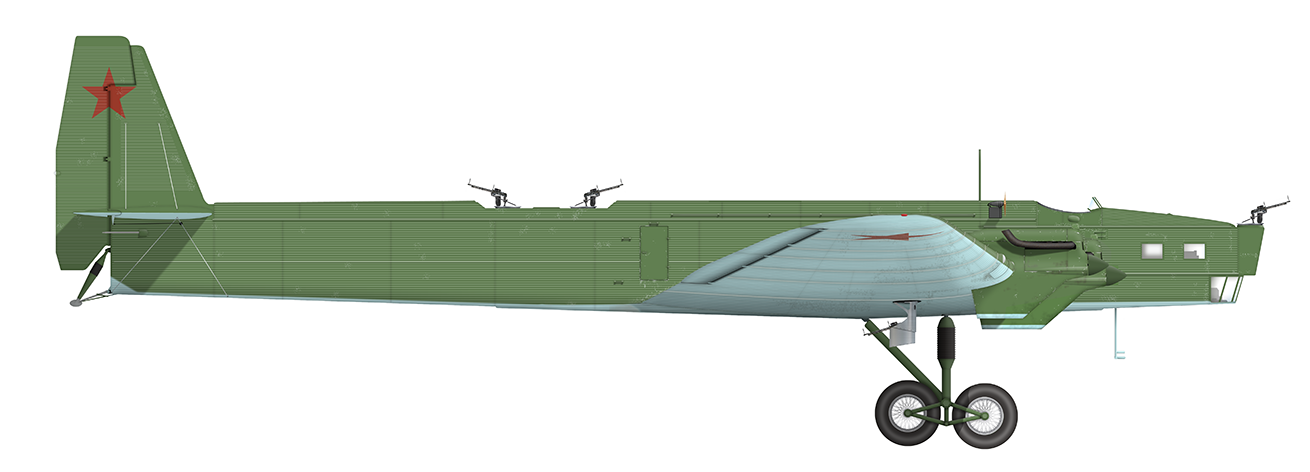
Given the date, one may rule out the use of any of the better known (and later) family of aero-lacquers such as AE, AEh, AII and such like; none of these finishes existed at the time of this image. The upper surface might have been painted with Army lacquer 3B. This was a general purpose military paint used for all manner of items-- vehicles, equipment, etc-- and was on no account any kind of specific aviation lacquer. 3B was a predecessor to, and part of the same family of finishes as, the much discussed 4B0 colour of the GPW era. This paint performed fairly well when applied to metal surfaces, such as the TB-3, but when used on fabric or wooden areas the results were disastrous and the use of 3B on VVS aircraft diminished rapidly during the 1930s. The under-surface colour looks to have been some kind of light blue of unknown nomenclature, in all probability similiar to the later finish AEh-4.

The following profile depicts these assumptions as applied to 3901.

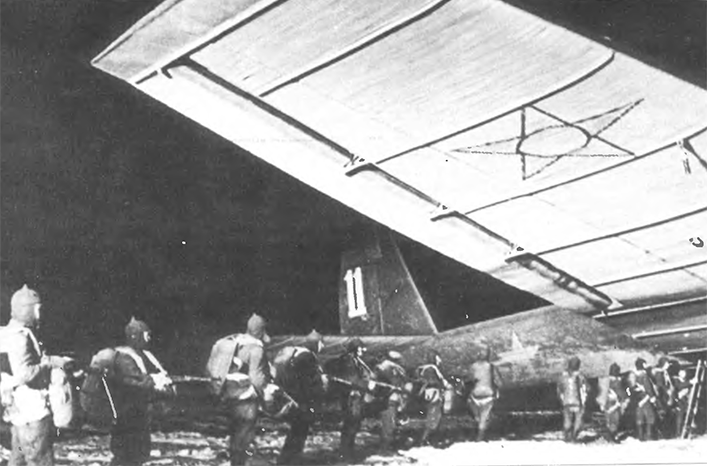
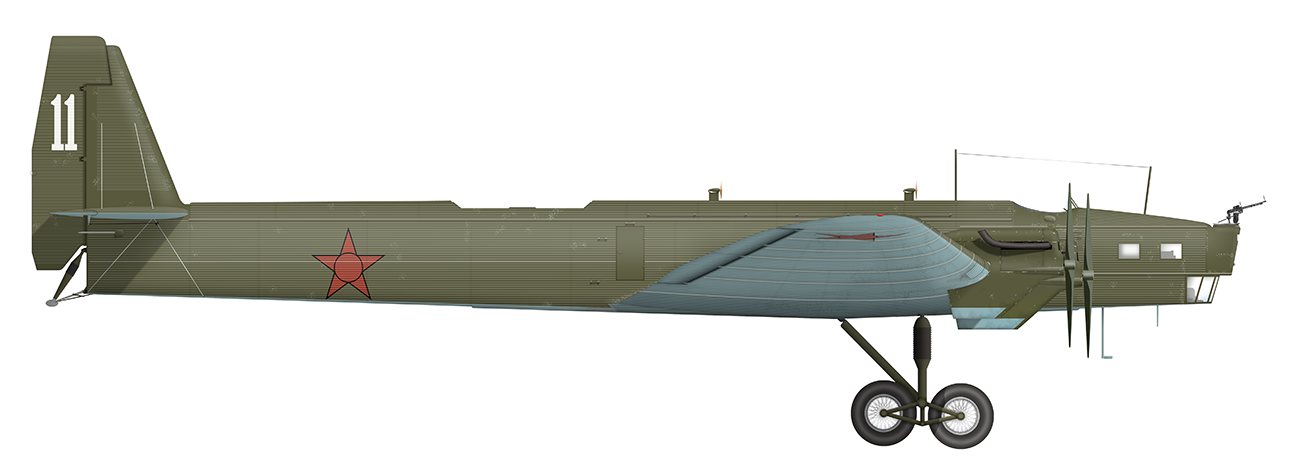
TB-3 4M-17F "White 11"

"White 11" was something of a movie star. This machine was the focus of a 1938 epic depicting the Red Army engaged in paratroop activities, both day and night exercises. As a result, the aircraft was photographed using at least two different 16 mm cine film types, not to mention still images shot on panchromatic stock. Altogether these various views confirm that "11" was still finished as it had been built at Factory No 22, complete with its dark 'German' finish and sundry details.


"White 11" seen at night from the aft starboard side.


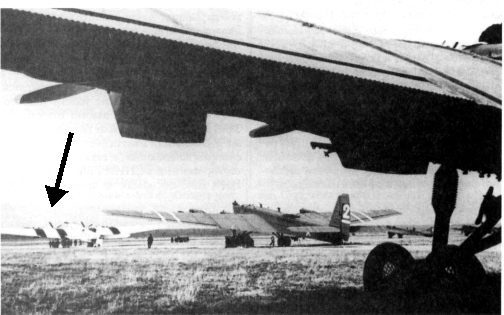
TB-3 4M-17 "Red 3" p/n 22-03

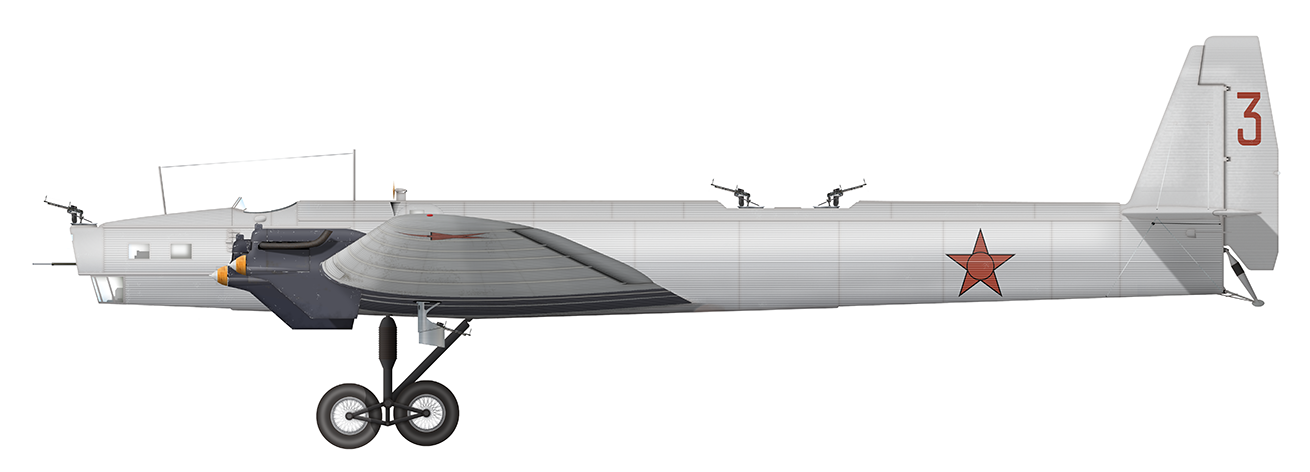
Several of the ANT-6 prototypes-- to include the TB-3 etalon from late 1931-- were finished in a classic Junkers style livery of over-all dull aluminium finish with black trim details. These liveries were absolutely unmistakable: they resembled in specific detail
any contemporary Junkers product, complete with black engine cowlings, black gear struts and large black stripes on the wings to hide engine soot (for example, compare them to a contemporary Ju 52/3m in Lufthansa service). A number of Fili's earliest TB-3s were also painted in this way, to include at least 22-01, 22-03 and 22-06.

This photograph purports to show TB-3 p/n 22-03 in VVS service, and dates from 1935. Most certainly the subject in the photo is wearing the Junkers dull aluminium scheme and features a red "3" on the rudder. The rather non-sequitur appearance of "Red 3" as compared to its squadron mates is a reminder that such schemes were not of typical Russian origin and underline the considerable influence of German painting practices on Factory No 22's behaviour at this time. The appearance and details of 22-03 are shown in the profile below.


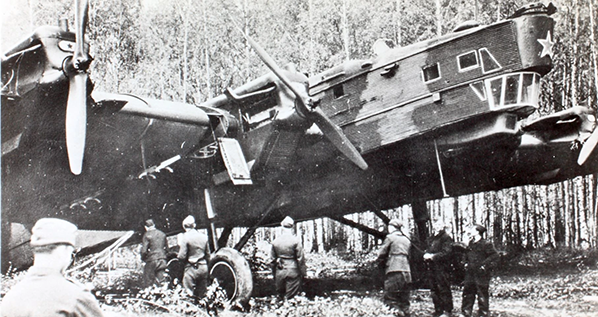
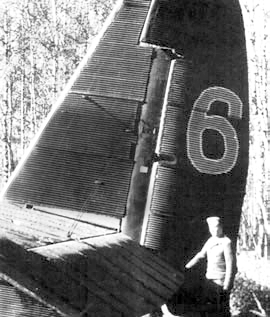
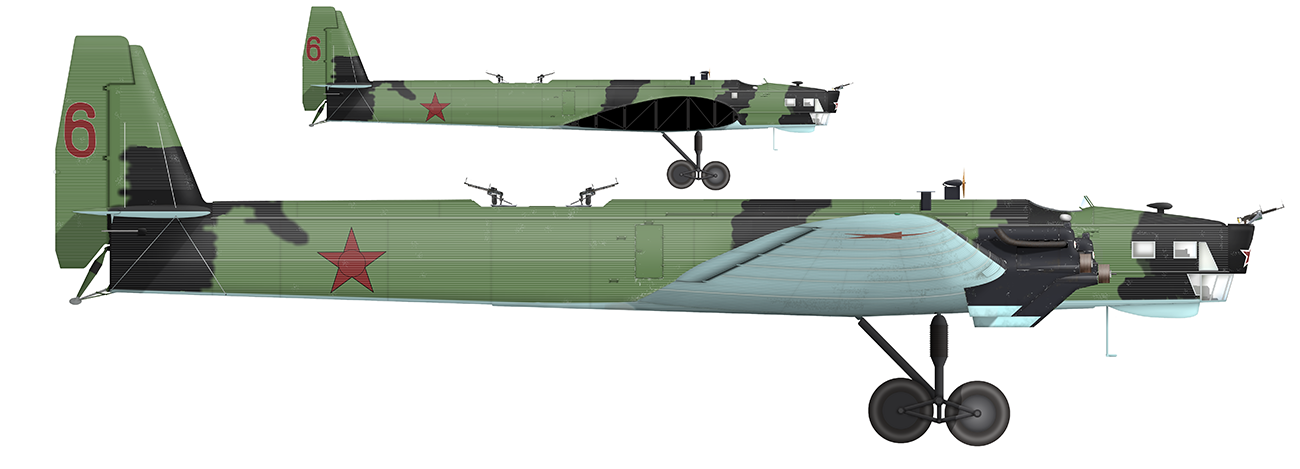
TB-3 4M-17F "Red 6" 1 Aviapolk ADD *

This rather handsome TB-3 is known from a series of photographs showing the machine under investigation by enemy soldiers. We may now say that this example cannot be "Blue 4". A photo has emerged of "4" showing the entire wreck, and it is most certainly not this aircraft. A photo of the tail has been found which seems to depict this machine, and upon examination one may conclude that certainly the location looks plausible, but alas we are left once again without a single, total view of this frustrating example. Be that as it may, the best current evidence leans in favour of this attribution (to "6"), and the profile has been amended accordingly.

....
Aside from the various physical and detail differences, note the considerably dissimilar colouration on this Factory 39 built model TB-3 as compared to a Fili produced aircraft. The upper and lower surface base colours are distinctly lighter and of greater sheen-- as also on p/n 3901-- and the exposed wing LE maintenance step is un-painted (or wearing a very light shade) and not finished with an RLM paint replica. The curious 'stripe' lower cowling demarcation is seen, however, and this oddity was something of a trademark feature on M-17 powered TB-3s from both factories (and disappeared on M-34 equipped models). Classic Khodinka style embellishments are clearly in view, such as the neat star-emblazoned intake bezel on the cowling, ShKAS nose gun, additional cockpit windows and the stylistically mandatory star applied to the nose. The black applique paint seems to have been brush applied and was rather rough in places.


Next installement: TB-3 M-34 models...

----------------------------

1. There were some Bureau offices additionally at Lefortovo (Moscow) and also Khodinka, depending upon the specific time and state of the programme.
2. Starting as RBAZ, then GAZ-2, then 1st BTAZ and latterly Avtobalt, it was then conceded to Junkers production from 1923-27. The facility was briefly re-named GAZ-7 before being reorganised as Factory No 22 according to the new GUAP scheme.