We were once asked (years ago), during a Ubi Forum conversation, "Where to start???"... Indeed so.
Getting It Wrong
There's an old bit of wisdom in aviation research which tells us that the first litmus test is to get the aircraft nomenclature right; if any information source does not, it likely must go directly into the bin. The IL2 family fell afoul of that condition from the off, and it was-- and remains-- a sign of more serious problems to come. Ironically for a Russian software company, it was with Russian aviation that the staff of 1C showed the least understanding. But poor research surfaced everywhere in the sim, and a general grasp of period historical aviation simply eluded them.
It is exactly this-- a conceptual failure to understand period historical aviation-- that is the great problem with the IL2 family. We have all noticed, for example, that the AI pilots act robotically; indifferent to the pursuing aircraft and their own, as they use the same modest set of "manoeuvres" in all cases. Well, not really anything like a proper manoeuvre of the era, but rather a heavily scripted 'movement' which usually defies the laws of physics (it makes the enemy hard to hit-- what else do you want?). The reason that they do this is expressly because the team at 1C had absolutely no idea what an actual pilot of WW2 would in fact do. And moreover, that is why there is virtually no code in the class files which causes them to differentiate between different aircraft adversaries (except for very crude type classes, like 'bomber' and 'fighter'). The failure to understand what specific evasive action that an authentic Spitfire pilot in 1940 might undertake can be seen as a skill set failure-- insufficient knowledge of that type. To fail to understand what a pilot might do against specific adversaries via their own aircraft's relative capabilities is a conceptual failure-- insufficient knowledge of the entire subject matter (e.g. WW2 aviation).
Conceptual failures are the hallmark of the IL2 family. If we had different, but incorrect, flight behaviours for each aircraft, that could be seen as a skill set failure (a rather serious one, given that this is a flight sim). In IL2 sim, however, all of the aircraft behave identically. Save for the sounds, the cockpit graphics and the various armament, there are virtually no handling property differences between any aircraft, no matter how different in reality. The failure to understand that aircraft have flight behaviours and individual characteristics, or what they should be, is a conceptual failure. The absurd Damage Modelling (DM), where huge chunks of aircraft structure tear off of the airframe, is another case in point. Such an erroneous impression comes from watching Youtube videos of gun camera footage, not realising that a) these little films are the exceptional highlights taken from hundreds (or thousands) of hours of footage showing the most astounding and spectacular incidents, not the typical ones; and b) that the way aircraft parts fall off in the sim, or that giant holes appear in the structure, defy every aspect of aviation engineering, materials science and the laws of physics. Conceptual failure.
It is one thing to have a poor aerodynamics model (and that is certainly the case). This may result from a limitation in coding skill, insufficent resources during development, or a host of other causes. But, no matter the limitations of this Flight Model (FM), basic aviation flight must be represented, even if it is scripted outside of the FM. Aircraft turning at an 80 deg bank whilst maintaining height? Conceptual failure. Turning hard for minutes (let alone seconds) on end without stalling? Conceptual failure. Heavily banked or inverted aircraft which do not drop like a stone? Conceptual failure. No useful implementation of g-forces, momentum and kinetic energy? Conceptual failure. Indeed, the behaviour of aircraft in flight in this simulation makes it manifestly obvious that the team have no understanding of this topic, conceptually or otherwise.
Well, but how can that be? How can persons with no real knowledge of flight or aviation history make an historical flight sim? We can only observe that this case was not the first time, nor certainly will it be the last. In fact, this case is the norm; that is to say, coders write sim software, not pilots nor aviation historians. Without very considerable expert guidance, they will obviously get it wrong as they know precious little about the subject (just as an aviation historian would be unlikely to code a java applet). The problem with IL2-- and to be fair, with most simulation software-- is that a self-devolving system of failure sets in as the sim gains in popularity: the coding team begin to see themselves as experts. Yes, they start out humbly enough (as did one O.M. years ago), gladly accepting help from those who are bona fide historical experts. Then they collect enthusiast material-- books and videos and the like-- which, quite tragically, they regard as research documentation. These coders then familiarise themselves with this desperate material, and lo-and-behold in no time at all they are historical experts! How daft that all those other "experts" wasted their time with years' of dedicated archival work, field research, museum conservation, pilot qualification, academic papers and lectures, book publication and the like. All they really needed to do was to browse a few gung-ho In Action style pamphlets, maybe do a search or two on Wikipedia (an advanced search, no doubt), and Bob's yer uncle! Sorted...
In Search of Popularity and Profits
There is another ugly aspect to simulation software which is rarely mentioned in public, and one which has existed since PC software began. The tragic fact is that lies which pander to public misconceptions and propaganda are profitable. And, since all of this sim software is underwritten by capitalist corporations, profits are the (only) motive behind the software. Any form of historical authenticity or scholarly interpretation is expendable to increase sales; so it has always been.
This state of affairs is pathetic, to be sure, but it is not the worst of the matter. The unspoken-- and disgraceful-- reality is that it is pro-Blue (that is a polite way to say pro-Axis, or pro-Nazi) bias which is profitable. Always. It is a well known and never divulged fact of simulation software (any genre) that the better the German equipment in the game, the better the sales. What is even worse is that this matter is discussed internally (within the software company) quite candidly, and the decision to twist reality in this way is deliberate and cynical exploitation. But for profits! Of course this is always a good thing? One must be a loathsome Communist to object to profiteering in this way, surely! Yes.. well... or an historian, perhaps.
Nowhere-- and we do mean nowhere-- is this pro-Blue bias more obvious than in IL2. Undoubtedly, the team at 1C will insist that this "alleged bias" is just an honest mistake, poor research into the topic, or what have you. An examination of the facts, however, will show that this defence is demonstrably untrue.
In the first case, we can document the increasing pro-Blue bias in the sim, chronologically, with each subsequent version and patch. These continuous modifications mirror precisely the popularity of the IL2 sim (sales, profits) over time, and in the more extreme cases preface a rise in popularity (patch 1.04, for example). An examination of the FM files shows this pattern well: the Bf 109 G-6's primary 'lift force' (parabCxCoeff) increased by 25% from 1.03 to 1.04. By patch 4.10 it had risen by another 10%. New and innovative research, this? We think not.
Some of the bias is just comical. In a desperation to make Blue aircraft better, all concepts of strutural enginnering went out the window. The Bf 109G's fuselage-- in reality a moderately built and vulnerable structure of monocoque design-- has a damage rating of 500, identical to the infinitely more robustly built Grumman F4F. The exceedingly feeble and vulnerable M.S.406-- recall that at this time the Morane-Saulnier was a Blue (Finnish) aircraft-- has a value of 800!! The Fw 189 was apparently not meant to be shot down-- its fuselage rating is 40,000. Now, compare these to the La-5's exceptionally robust wood-plastic laminate fuselage, 450. Or the Yak-1's virtually indestructible welded heavy guage chromium steel tube fuselage, 400. No amount of error-- skill set failure-- can explain such absurd proportional values; this is deliberate pro-Blue cheating.
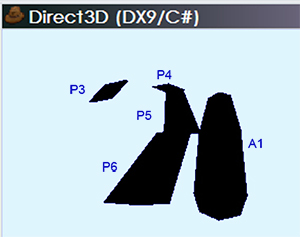
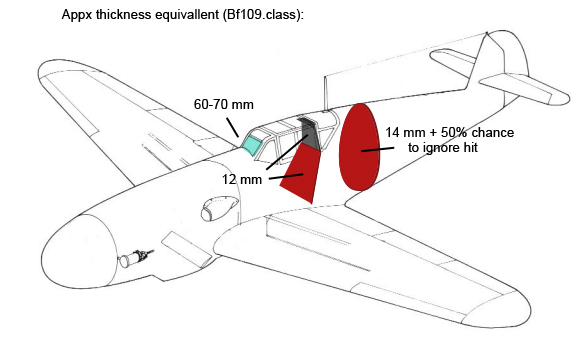
But it gets worse. To ensure that the Bf 109 is essentially unbeatable, the team invented giant pieces of thick, make-believe armour plate and slapped them into the 3d model. This image shows these pieces exactly as they are in the sim's Bf 109 G-2.
 |
 |
| The 3d armour pieces as per their collision model (courtesy of Dr Jones' Mesh Converter) |
How these fit in the aircraft 3d model |
Moreover, this huge aft armour plate has greater durability (or thickness) than the Il-2 Shturmovik's main face-hardened nickle-chromium steel armour plate of 12 mm thickness!
On the contrary, this image shows the actual armour pieces in the historically authentic Bf 109 G-2.
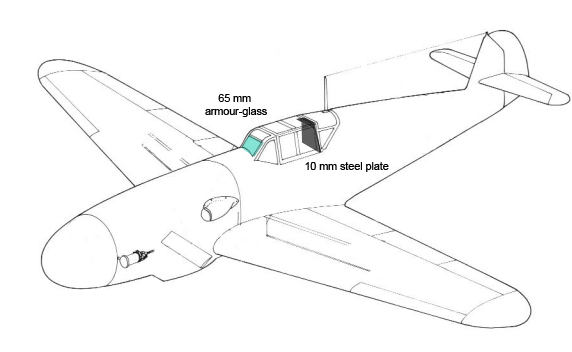
One could scarcely make this stuff up! Of course, it's an insult to our intelligence to claim that all of this nonsense is accidental; a mistake. There exists no reference source anywhere on this planet which shows such a ludicrous armour plate in a Bf 109 fuselage (so as to mislead the 1C staff). This stupidity is flagrant, pathetic, deliberate pro-Blue bias. And, for pro-Blue cheating, the Messerschmitt is only the tip of the iceberg in IL2...
Dear Me... What Can Be Done?
A lot can be done, in fact, to correct the worst of this historical inaccuracy. Indeed, this very remit is our own, VPB, mission in regards to IL2 modding. The changes which have been realised are vast, indeed-- from nomenclature to weapons load-out, FMs to DMs, and much more besides.
Let us first be clear, however, to explain what we cannot change in the IL2 sim. We are stuck with the game's physics and Flight Model, such as they are. To revise these core elements would require--and logically would suggest-- to create another sim from scratch. As a result of this unhappy reality, it is therefore categorically impossible to create historically accurate aircraft FMs. This cannot be done. However, it is certainly true on the other hand that the FMs in the sim can be improved, and this has been done. When it is impossible to achieve the necessary accuracy and fidelity in the aerodynamics model to replicate genuine flight behaviour, the primary goal for any flight simulation is to ensure above all else that the relative flight behaviours of the aircraft in the sim are historically accurate. This means that the specific advantages and disadvantages of each design, as compared to any other design, are preserved. More than this, it is often possible to use tricks and sneaky bits outside of the FM code to imbue aircraft with their respective quirks and personalities, and of course these must also be historically authentic.
VPB's work on the IL2 sim FM follows this path. The relative flight behaviour characteristics for all aircraft in the sim are correct, at least to the absolute maximum extent that is possible within the IL2 framework and our current understanding of the file architecture. Many of the aircraft demonstrate their historically recognisable 'personalities' and quirks which have been simulated using various methods. Flight and aerodynamic properties have been made more convincing-- energy loss, stalling, and various effects have been coaxed out of the FM system to a more compelling degree. In effect, flying is the primary activity in our mod, and mastering the intricacies of any given design is challenging. Presuming to master some 500 such designs (as is easy in the stock sim)... well... that seems a bit unlikely.
With a view to enhanced authenticity, many changes have been made to the mechanical aspects of the sim. The Damage Model (DM) has been radically re-worked, as have the corresponding characteristics of the weaponry. Spurious items, and cheating, have been removed. The aircraft in the stock sim seem to be made of papier mâché-- even bursts of rifle calibre fire rip wings off of bombers, and such like. No more. Aircraft of WW2 were lost-- that is, to damage from enemy fire-- primarily to a failure of the cooling and lubrication system; then to the fuel system; then to physical damage to the engine; then to physical damage to the crew; and finally to loss a aerodynamic propensity ('airworthiness') resulting from the loss of lift, of thrust, and of increased surface drag. In that order. Statistically speaking, loss to major structural failures ("wing rips off"), control mechanism failures ("rudder cables broken"), ammunition explosions and the like were so rare so as to be virtually meaningless in the typical case. VPB sim aircraft follow the historical loss pattern, not the ridiculous Youtube/IL2 version. The durability of each aircraft's component sections have been corrected to historical values which obey the rules of materials science.
A very great deal of effort has been applied to the sim's Artificial Intelligence (AI). The game's AI are notoriously inept, and occasionally so too are ours. However, that said, they are much improved over the stock versions. Our AI pilots take note of the type of aircraft they are flying vs the type of adversary which they face. This comparison informs their decision making (the so-called 'decision tree') in both attack and defensive manoeuvre. Further, these decisions are influenced by their skill level, as are their fire-on-target decisions. In the stock sim it is the usual 'evasive action' to fly in a slight curve and invite the AI to use up all of their ammunition in vain. Try that with our AI and see what happens. We struggle to make them manoeuvre in a way which highlights the advantages of their aircraft; this they often do, but alas sometimes they do not. Work continues. A brief mention that our AI pilots are also fallible; push them hard enough and they will mishandle their aircraft, indeed to the point of stalling and crashing.
Historical fidelity in aircraft versions, equipment and variants is essential. Our work focusses heavily on these properties as well. Gone are the many erroneous aircraft type nomenclatures and models, these replaced by authentic ones. Many of the game's armament load-outs are preposterous; we use historically described bomb loads, ammunition totals, and weaponry. Those with a keen interest in the Soviet VVS will be especially pleased, we think-- gone are such absurdities as "Il-2M3s", "I-16 Type 6s", M-62 and M-63 powered aircraft with negative-g cut-out behaviour, and so on; this list of corrections is very long indeed. We must add here that these historical corrections are ubiquitous and affect all the countries in the sim. Our Phase 7 modifications included a revamp of the sim's torpedoes, for example [download our torpedo guide]. Could someone please explain to us where all of these ludicrous and make-believe guided torpedoes have come from??? It seems clear that some of these have been confused with late-war Kreigsmarine models (fired from U-boots, Z-Destroyers and shore batteries), usually experimental ones, but transmogrifying the Italians' absurd little W120 (in Luft use "LT350") into some kind of Cold War era guided missile just beggars description. Another classic 1C conceptual failure.
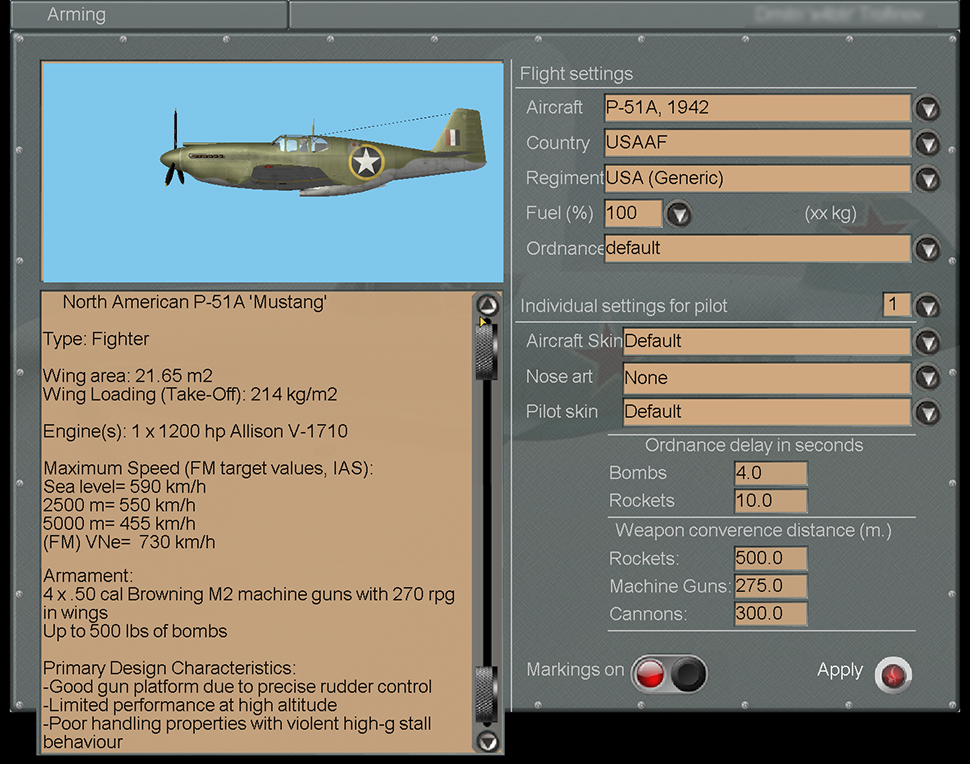
Lastly, we have to mention the improved interface designed by our genius coder. Rather than staring at empty space, or unnecessarily large spinning 3d models, we have put into place a text information field which contains all sorts of interesting data about the selected aircraft. It occured to us that not every pilot would be familiar with all 500 (or so) machines in the sim; and even if they were, it is helpful to have this material at one's finger tips to remind.