e.-


Douglas A-20 and Boston
Anti-Shipping Modifications of the VMF


Much has been-- and continues to be-- written about the various aircraft supplied to the USSR via Lend-Lease. This work is essential, and not infrequently controversial, as a better picture emerges of the actual efficacy of certain designs, and of the rationale for some of these machines' delivery to the hard-pressed Soviet Union. However, one aircraft really does stand out in this respect, a design well liked by all of the many nations who flew it in the war, and absolutely appreciated by the Naval Air Service, the VVS-VMF. This aircraft, of course, was the Douglas A-20 (or Boston to the RAF).

Even so, the A-20 was not just a reliable and rugged servant of Soviet Naval aviation, it was very versatile as well. The aircraft revealed this remarkable ability in the multitude of modifications undertaken on it with regards to the ever changing Naval requirements and weaponry of the GPW era. "How can we attack with 1000 kg bombs?" Modify a Boston. "How to get enough mines into that location?"
Modify a Boston. "Increased enemy air activity during ship attacks?" Modify a Boston. These various and wonderful modifications are the topic of this article, and thereby we hope to uncover and illustrate some of the more satisfying examples of the Douglas A-20 in its heroic service with the Soviet VMF.


A, and Not B?

Why was this Douglas design-- originally the DB-7 in fact-- named A-20 in USAAF service and not the B-20? "A", for the Air Force, stood for "attack" and not bomber, which was "B". This designation was appropriate for the aircraft, in that its bomb load was less than that of a dedicated bomber, but its fire-power and agility were greater. Indeed, it was intended from the start by Douglas that a 'gun nose' could be swapped with a 'bombardier nose' on the type, even in the field if needed, and while this capability did not really materialise on examples in Western services, the VMF did implement this possibility a bit in reverse. The airframe was rugged (and latterly improved by sheets or armour plate bolted onto the sides) and its radial engines less vulnerable than in-line types to enemy fire, giving the A-20 improved survivability at low altitudes, as was suitable for an Attack type. Performance at low altitude was also reasonably good, rather than being optimised for bombing from height.

In VMF Service

Many have observed with fascination that the VMF operated several types of bomber aircraft during the war in the same role, and naturally wondered why? In the simplest of terms, those aircraft were the ones they were given. However, the situation was not quite as straightforward as that. It was found that the Army preferred the Pe-2 to the A-20, and thereby requested such machines as a priority, whereas the VMF preferred the A-20. Il-4s were equally prized, and thus split proportionally, albeit in rather different methods of employment. Early on, as everywhere else in the world, the VMF was convinced that the Pe-2 would be ideal in anti-shipping duties as a dive-bomber. Time and experience debunked this fetish-ist idea, and Pe-2s served as level bombers in the main. But, the A-20 could be easily modified to carry torpedoes or bombs, so from the VMF point of view these were the better option. In general, of course-- Pe-2s served very well indeed in the VMF, also. But above all else, perhaps, the A-20 could be modified to suit the needs of the minute, and perhaps this explains why these aircraft were so valued by the Navy aviators.

Modifications

An exhaustive list of A-20/Boston modifications by regiments of the VMF is simply not possible. And some such modifications have been spotted on Army service A-20s, as well, making their origin somewhat dubious. However, in addition to looking at specific examples in VMF service, attempting to identify exactly what had been done to these aircraft, one can also discuss to a degree the more common features of this work.

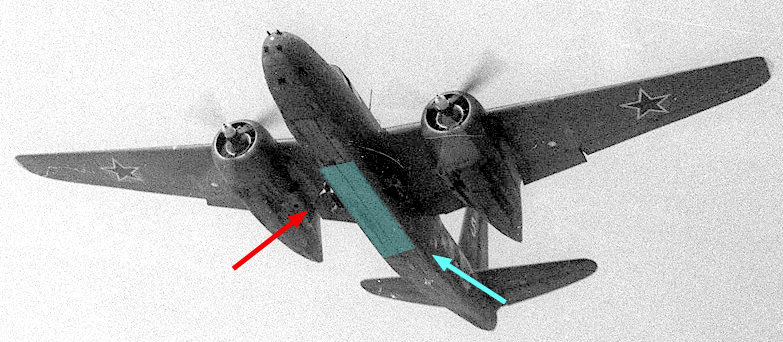
One of the two main changes made to VMF A-20s was to mount an external bomb rack to the aircraft so as to accommodate larger weapons that could not fit into the bomb bay. The A-20 had been designed with a narrow tandem bomb bay which could fit at most the US 500 lbs bomb. The VMF regarded this calibre-- roughly equivalent to their own 250 kg weapons-- as being thoroughly inadequate for use against shipping, even merchant types. The external rack was quite heavy in construction, and even if there were more than one specific example, many were quite similar in appearance, and in the vast majority of cases they were mounted on the starboard side.

The second main area of modification for these Naval machines involved the crew stations for the bombardier and gunner. In fact, most -G models replaced the bombardier with four fixed .50 cal guns in a 'solid' nose. For operations in the attack role this was useful, but increasingly the VMF wanted to employ the A-20 as a torpedo bomber-- for a 1000 kg load that weapon delivered the biggest threat to ships. As a result, many -G models in the VMF had the bombardier's compartment restored, in these cases using all manner of window arrangements. Torpedo attacks by aircraft with a dedicated bomb aimer, of course, obtained much better results.

As for the gunner, Soviet aircrew did not particularly fancy the Martin turret. The unit was cramped, hard to see out of and nearly impossible to enter and exit during combat flight [recall the the gunner had to operate both the upper gun/turret and also the lower hatch gun beneath, thus requiring that they change position]. In its place an MVT turret was installed, and even though this unit could accommodate only a single gun (in practice, virtually always a 12.7 mm UBT) it was considered a major improvement. The .30 or .50 cal weapons in the lower hatch were also replaced by a UBT in many cases.


Before the Profiles, a Brief Discussion of A-20 Finishes

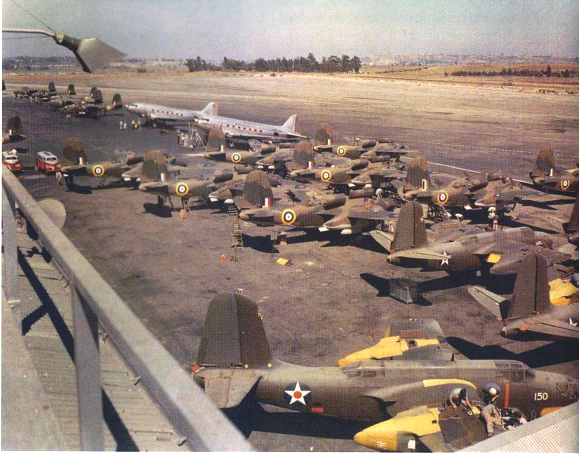
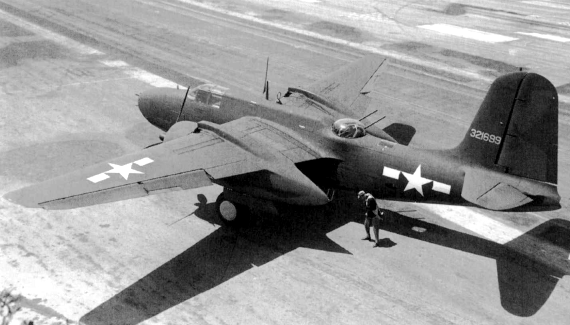
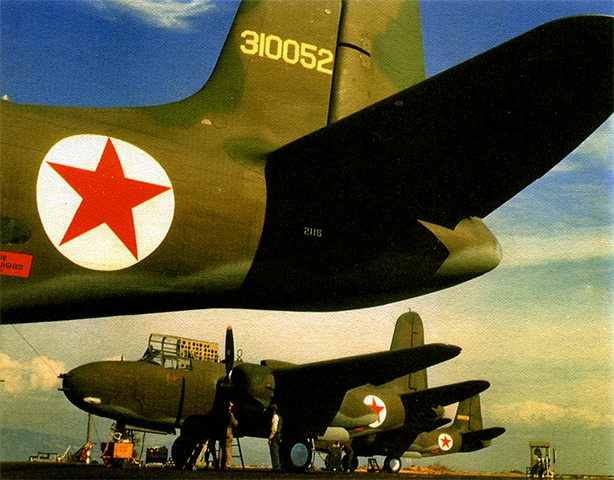
The matter of USAAC camouflage and finish in the 1939-42 period has been-- and perhaps remains-- a matter of complexity and some controversy. The A-20, necessarily, fits very well into this problem. However, having said that, we are blessed by a fair number of colour photographs of Douglas manufacture, most particularly from their main Santa Monica (California) plant. This article is not the place for a full discussion on this topic, but suffice here to say that the factory finish of any machine was usually dictated by the contract under which it was built. That sounds fairly logical, and it is, but therefrom field work also took an almighty toll on any machine's contemporary appearance.


A lovely photo taken at Santa Monica on good quality colour film.

Also, the use of older lacquers for series production was interesting and carried on much longer than one might think, adding a further layer to our uncertainty about these schemes. The Government had written to the aviation factories explaining that they were allowed to use up older stocks of paint, but in all other cases the new ANA finishes from Du Pont should subsequently be employed. This rather innocuous comment, however, was interpreted quite differently at some of the factories building aeroplanes. At Douglas Santa Monica (-DO), this instruction was apparently interpreted to mean that they would not be using ANA 613 at all, as apparently stocks of the older QM paints were still on hand even into 1944!  [The A-20 was specifically omitted from USAAF instruction 07-1-1 due to the propensity of "overseas users".]


43-21699 on the hard stand at Santa Monica

Tools of the Naval Trade

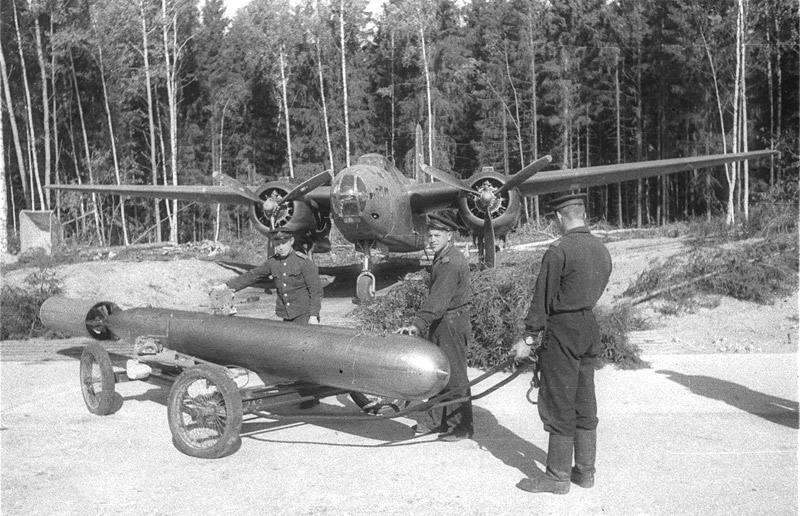
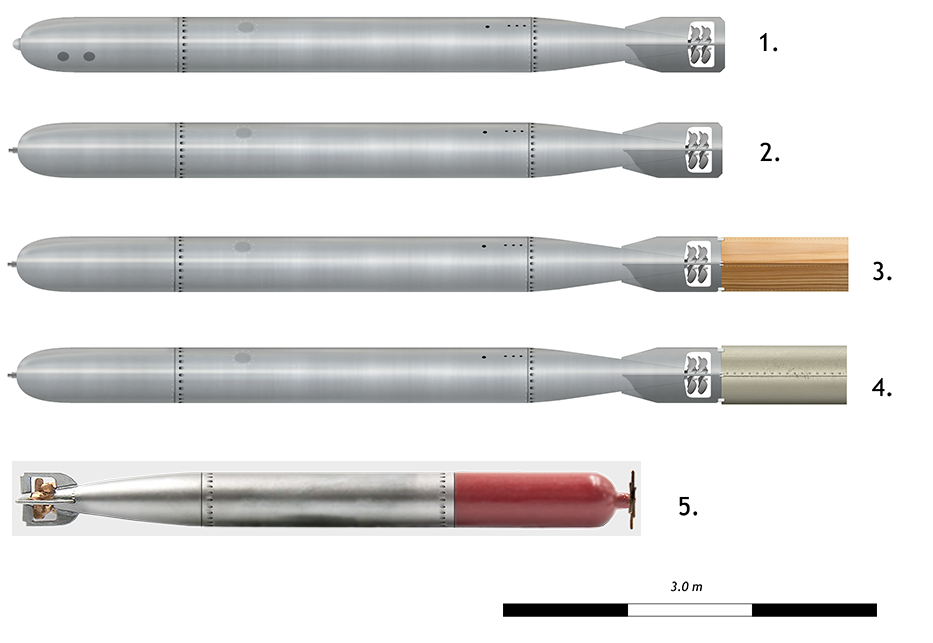
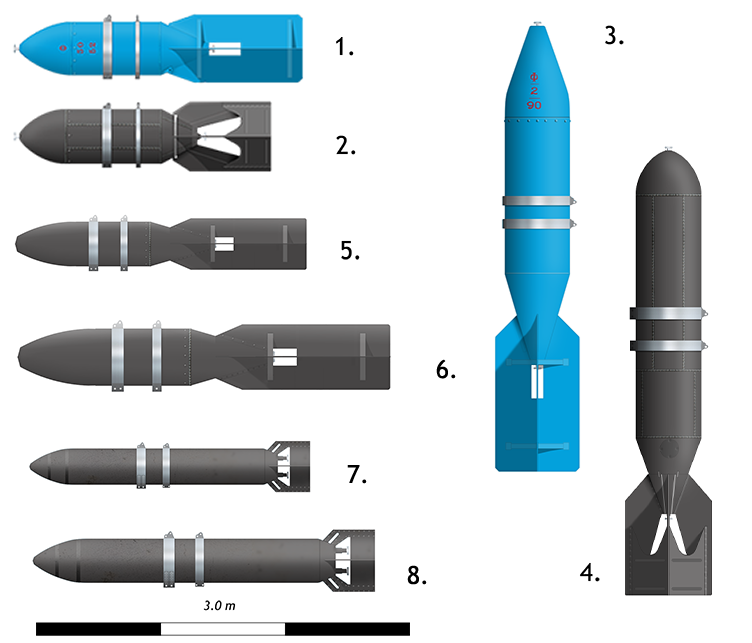
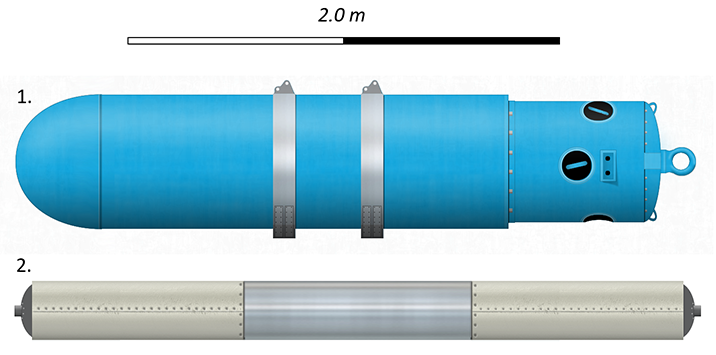
We can start our discussion with a brief look at some of the weapons used in these A-20/Boston modifications. The following graphics show the main types carried (externally) on these A-20s.

Torpedos

1. 45-36AVA (earlier TAV-12A was externally similar)
2. 45-36AN
3. 45-36AN with wooden stabiliser fins
4. 45-36AN with drag chute container
5. British Mk XII 18"

Bombs

1. FAB-500SV    [FAB = General Purpose Bomb]
2. FAB-500M43
3. FAB-1000SV
4. FAB-1000M43
5. BRAB-500SV    [BRAB = Armour Piercing Bomb]
6. BRAB-1000SV
7. BRAB-500M43
8. BRAB-1000M43

Mines


1. AMD 500 (blue finish)
2. Air Launched Mine Type A Mk I to IV


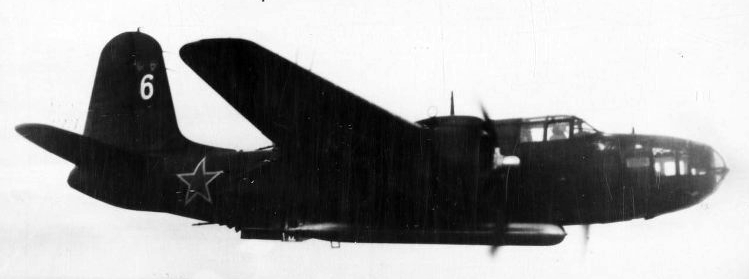
A-20G "White 6", 1 GvMTAP, 1944


"White 6" was likely a G-20 model, but alas the serial number had been painted out, and thus making a certain determination on this matter is impossible. The photograph (above) leaves very much to be desired, and only by manipulating the image in sections can any headway be made with an analysis of this aircraft's appearance.

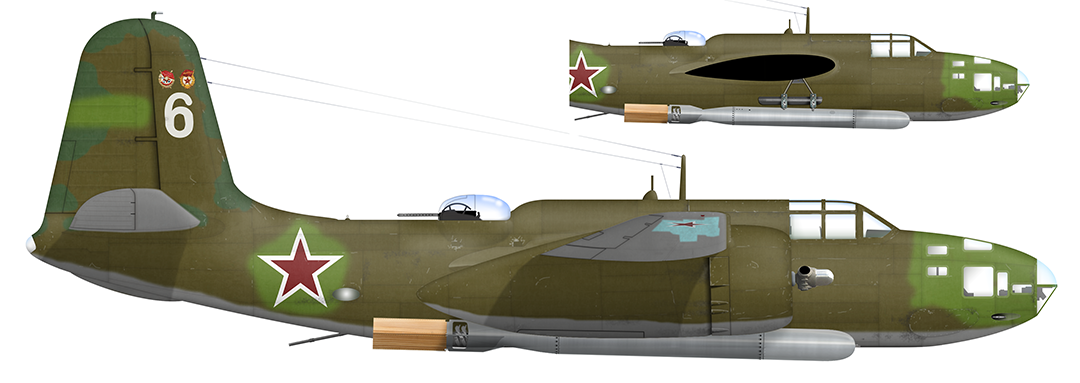
Physically, the most obvious modification occurred on the nose, where the fixed four-gun armament was removed and replaced by glazing for the bombardier. The nose piece was taken from an earlier model A-20 or Boston, and the subsequent clear panels aft of this were arranged in manner as seen on several 1 GvMTAP examples. The Martin turret was retained aft, but the bottom .50 cal weapon was replaced with a 12.7 mm UBT gun. The external bomb rack was mounted to starboard in the usual manner, and in this case it carried a 45-36AN torpedo with a wooden stabilising fin.

The factory finish was typical for most Douglas -DO (Santa Monica) machines. Older QM-41 Olive Drab was used over Neutral Grey, the former here shown in a middle state of oxidation (darkening). Blobs of Foliage Green were dappled along the fin, wings and stabilisers in the typical manner. Patches of ubiquitous AMT-4 Green were used to re-paint the nose, and to obliterate the white disc around the national star and possibly the serial number on the rudder. The wing under-surface cannot be seen in the original image, and thus an area of AMT-7 Blue has been added speculatively to cover the USA marking for the VVS star. A small Order of the Red Banner and Guards Emblem were applied abouve the tactical number "6".

These A-20G-20 models were photographed prior to delivery and demonstrate the older QM-41 finish with Foliage Green dapple. The serial number was habitually
applied to the fin, so the lack of any evidence of such on "White 6's" fin is curious.

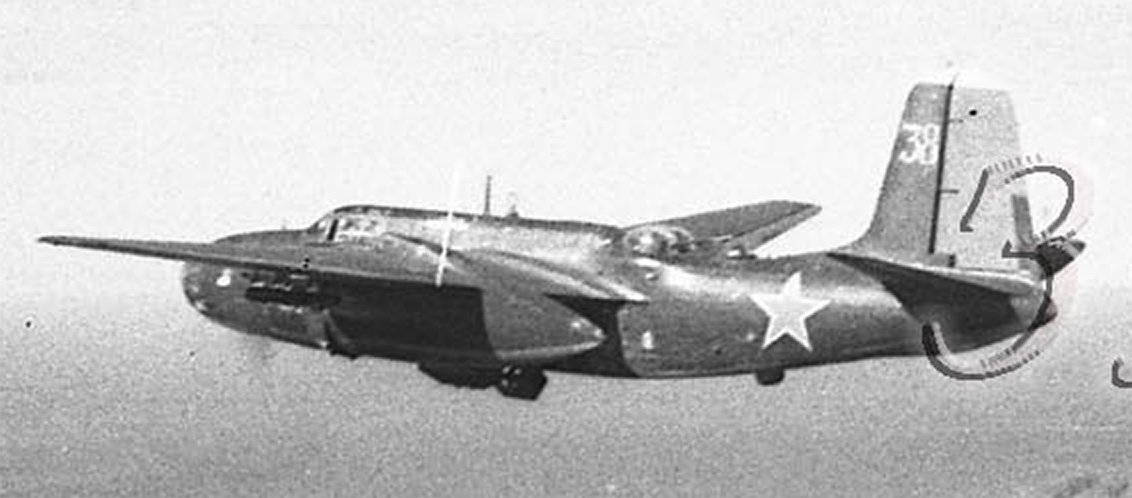
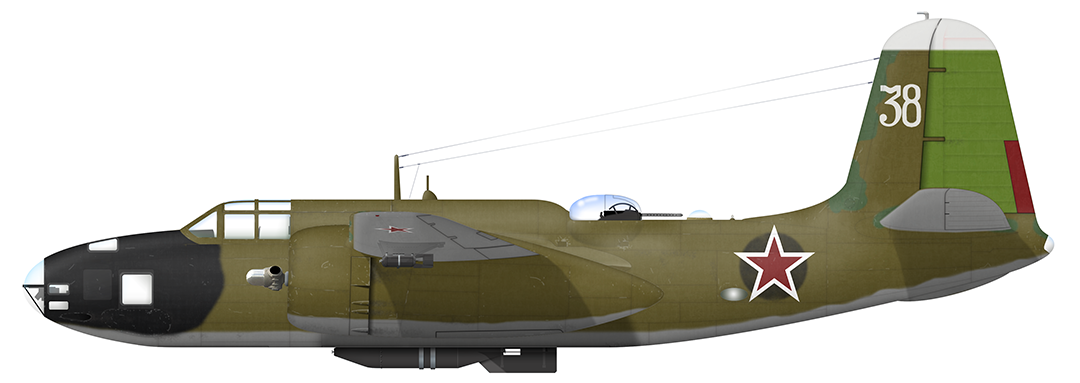
A-20G "White 38", 9 GvMTAP, 1944


Another -G model was this machine, "White 38" of the 9 GvMTAP. The nose has been modified somewhat similarly to "6", above, but with fewer side glazing windows. A number of contemporary A-20s in VMF service were fitted with a small observation radom over the gunner's escape hatch. A FAB-1000SV [painted with No 67 grey] was mounted on the external rack to port. Most Soviet operated A-20s seemed to have discarded with the outer wing bomb racks, but "38" in fact has two of them, each carrying a FAB-50 munition. This fact is additionally curious in that the Navy determined that bombs smaller than 500 kg were useless against ships, and indeed preferred 1000 kg weapons as a rule.

The original finish would have been identical to the usual factory scheme, as on "6" for example. It appears that black (here shown with AMT-6) was used to cover the white disc under the star, and also over the nose modifications. The rudder was painted with AMT-4, and the trim tab with red (as was commonly seen in some regiments). There is no evidence of painting out a serial number on the fin of "38", as above with "6".

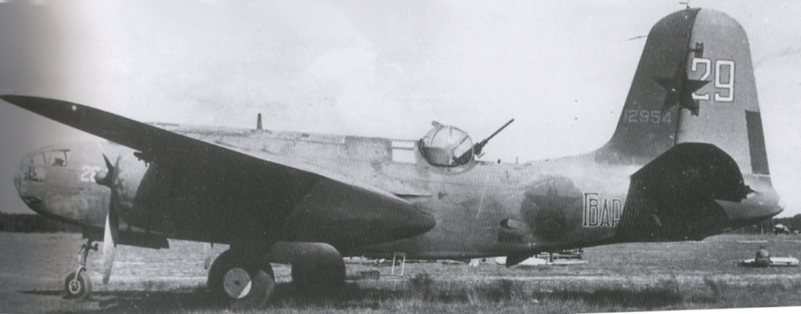
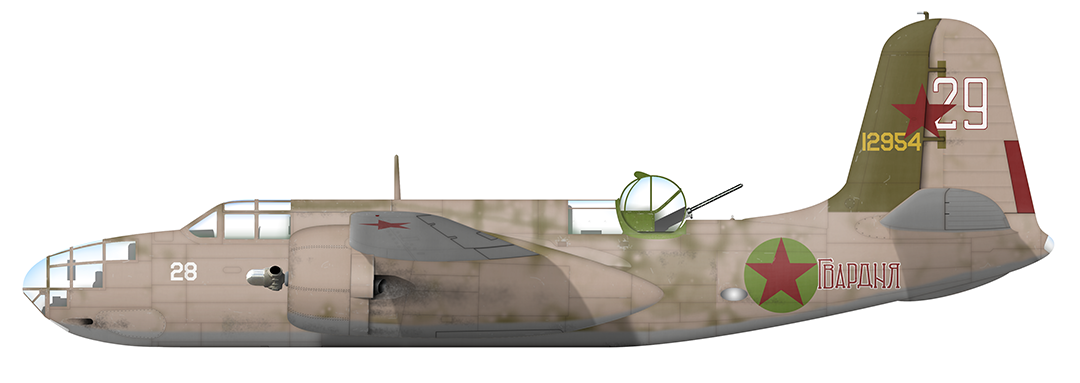
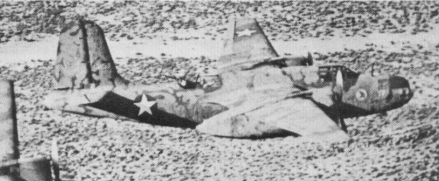
A-20B "White 29" 41-2954, at the NII VVS, 1943


The USSR received many models of the A-20 and Boston, indeed perhaps all of the varieties built (even some DB-7s)! 41-2954 was a -B model, which in fact meant a version from the new factory at Long Beach (California), this likely explaining the old style nose glazing on the type. A number of these aircraft were sent to Northern Africa for service with the 47th BG, and thereafter on to the USSR via Abadan. "White 29" had received a modification with the fitting of an MVT turret to replace the open gunner's position, in this case mounting a US .50 cal Browning M2, but more usually a Russian 12.7 mm UBT. The aircraft was photographed being evaluated by the NII VVS during the spring of 1943, having been in service prior with the 1 GvMTAP. "29" was subsequently evaluated by the LII, but it is not currently known what became of it thereafter (returned to the unit or not?).

The exact appearance of this most colourful example has long been a mystery. The tonal properties of the image suggest a main colouration which does not correspond to any VVS use lacquer of any type. Therefore, what could it be? Surely the fin remains as it was built (QM-41), complete with yellow serial number. The shade around the star and on the turret is somewhat lighter than this, matching the ubiquitous AMT-4 Green. The stars, numeral trim, trim tab and inscription were all red. This mysterious main colour is worn in many places such to the point of revealing a darker underlying colour, no doubt QM-41. To the author, this reminds precisely of some of the A-20Bs sent to North Africa which received appliqué dapple of the US Army finish QM-49 Sand. This paint was usually employed as a water-based finish for temporary use in theatre, but interestingly it thereafter proved rather more difficult to remove from the painted surface than had been advertised. Aircraft with quite fresh looking Sand surfaces in the USAAF have been proven by colour photography even into 1944, sometimes almost two years after application. Without any other obvious candidate [technically, one could speculate on the use of the very rare finish AII Pesochnii, but where would the VMF from the Baltic ever get a hold of such paint!?], the author feels that this is the most likely answer.


An A-20B of the 47th BG with QM-49 Sand applique.

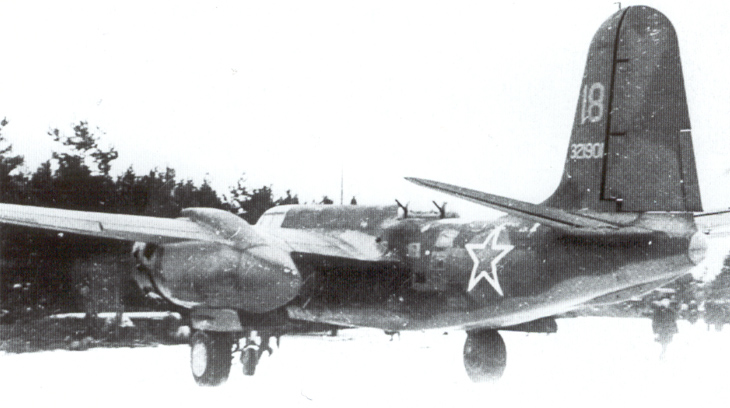
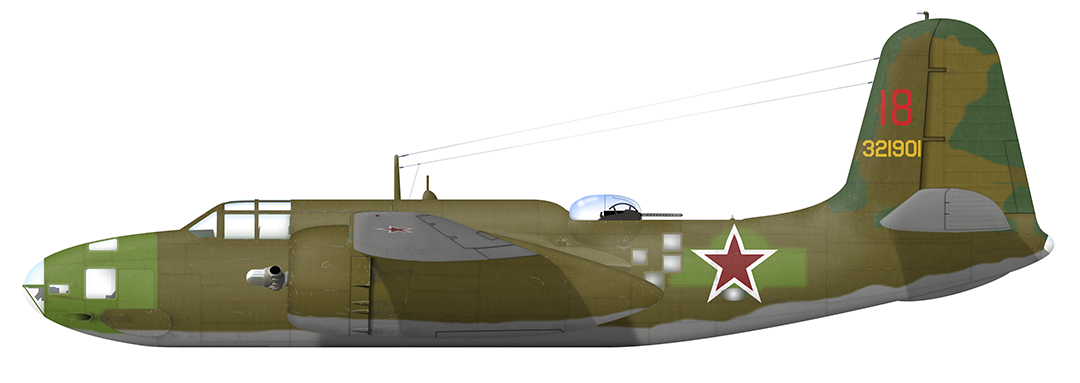
A-20G "Red 18" 43-21901, 51 MTAP, 1944


Another later -G model was this aircraft, "Red 18", of the 51 MTAP. There were a fair number of modifications on examples which retained the Martin twin .50 cal turret which addressed the poor visibility from this unit by the installation of extra windows along the fuselage sides. These windows varied widely in size and placement, those found in this case are a bit smaller and more interestingly positioned than others. A bomb-aimer type nose was installed for torpedo attack work, additionally.

The finish was rather typical in most respects, with applications of AMT-4 made where the modification work was undertaken. The slight tonal variation between the rudder and the metal areas of the fuselage was extremely common on QM painted airframes. The numeral appears to have been applied with a locally sourced red paint, or perhaps even A-13 Red interior primer.

Boston IIIA/A-20C "White 13", 15 MRAP, 1943

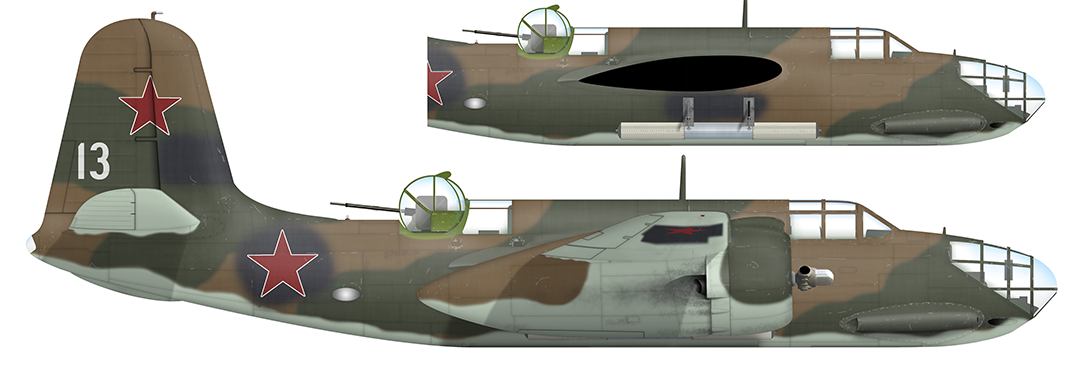
It is impossible to know whether this machine was actually supplied to the RAF as a Boston Mk IIIA and then sent onwards to the USSR, or was one of the examples commandeered at the factory for the USAAF as the A-20C. Be that as it may, the aircraft was subsequently modified with an MVT turret and an external bomb rack. The rack itself was of a somewhat earlier design than elsewhere, here shown via the inset drawing [above]. "White 13" was carrying a British mine Type A when photographed.

The finish was a classic factory application for export aircraft of Du Pont equivalents for Dark Green, Earth Brown and Sky [see colour image above]. Quite often one sees that the VVS used Black paint (and not AMT-4) to cover up the original markings on these schemes, as no doubt these shades looked very dark to their eyes. National star insignia were added with a thin white border, except on the wing unders which were plain types.

----------------------------
...to be continued in Part 2