The Tupolev TU-2 -- A Cautionary Tale


A.N. Tupolev's name and Bureau hardly need any introduction. Even in the West, his designs are part of the every day aviation vernacular and are widely known and appreciated. His iconic bombers still serve in the Russian Air Force, as they have done for many decades before, and civilian designs from his corporation carry on likewise. The story, therefore, of the clearly outstanding "Project 103" aircraft-- latterly to become the Tu-2-- are mysterious. Why on earth did it take so long to see these aircraft in series production and service (1944, essentially) when the first prototype flew in May 1940? Why does no agreed explanation of this unprecedented delay circulate amongst the learned of aero-industry history? Something here smells amiss, and this article on the Tu-2, we will try to shed some light on a possible set of answers.


Tupolev's Early Work and History

Andrei Tupolev's involvement with the Soviet aviation industry began from the very start. In 1921 he was voted to become assistant to none other than Professor N.E. Zhukovskii, the father of aerodynamic development in Russia. During these early days at TsAGI, Tupolev showed his competence in the investigation of metal structures and light alloys. His thesis for graduation had actually been about hydroplanes, and he spent a lot of time in these early years designing and building speedboats and aero-sleds. His testing methods for these metal structures was considered to be quite good, and indeed his aero-sleds eventually served with distinction during several Polar exploration trips. In fact, virtually all of Tupolev's early years at TsAGI related to the testing and development of light metal alloys, and in 1922 he was placed in charge of an entire design brigade for this purpose. He was an early proponent for the adoption of duralumin for aircraft construction, thereby gaining his first serious education in industrial diplomacy by locking horns with the traditional wooden construction stalwarts.

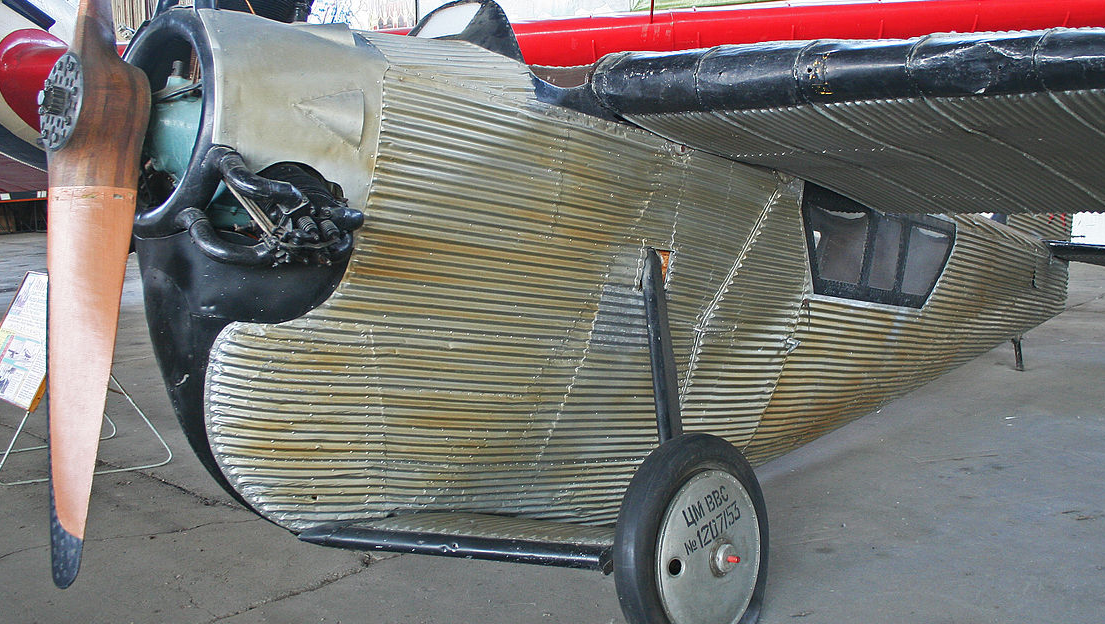
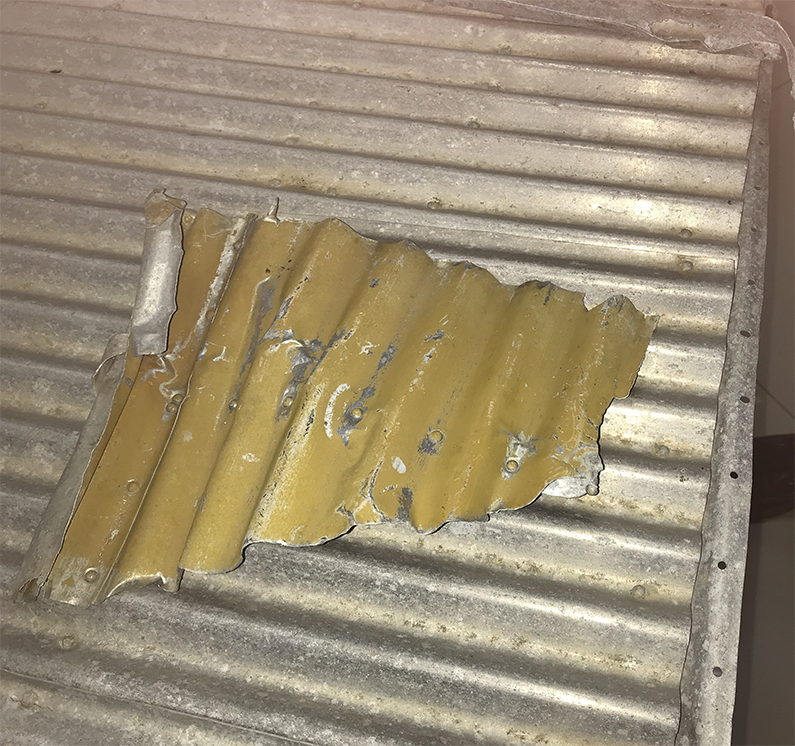
The first aircraft to bear his moniker "ANT" (for A.N.Tupolev)[1] was the ANT-1 monoplane, a light sports machine of mixed construction. Nothing about this aircraft suggests any involvement by Tupolev, and more than likely he had little to do with its design, especially noting his heavy involvement in contemporary alloy testing. The subsequent ANT-2, however, clearly shows Tupolev's direct involvement. This machine was a high-wing monoplane with an open cockpit for the pilot and small interior cabin for two passengers. Construction was all-metal, employing the early duralumin alloy jointly developed by TsGAI and the factory at Kolchuginsk. The fuselage was clad in corrugated sheet, which upon visual inspection is not identical to the Junkers method, as stated so many times. However advanced in material construction, the aircraft behaved poorly and was rather mediocre; a very modest number were built.

The R-3 sesquiplane followed-- the ANT-3, of course-- which in its civilian guise was known as the PS-3. This aircraft again showed the Tupolev construction method, and also again demonstrated poor flying characteristics and performance. Production was modest, about 80 examples in all. It is true that a couple of PS-3s did undertake some very notable long distance flights, and their structures held up well to some punishing conditions, but pilots were unanimous in their lack of enthusiasm for the type.

Captain of Industry

In the autumn of 1924 Tupolev was appointed head of TsAGI AGOS [2] with a staff exceeding 300 people. His main design team had now crystalised, consistinmg of Petlyakov, Putilov and Arkhangel'skii. Tupolev, of course, increasingly took on new and greater administrative duties as befitting his position, and also became increasingly embroiled in the intercene politics of the industry. In January 1925 Tupolev led a TsAGI deligation visit to Germany, and specifically to meet with Hugo Junkers and his company. At that very moment, Junkers AG were building aircraft in Moscow at a factory located in the leafy Fili District according to Junker's all-metal corrugated skinning method (for which they had threatened to sue the USSR for patetnt violation earlier). There is no known record of what was discussed on this trip. However, while the contemporary ANT-3 was built using the Tupolev all-metal corrugated skin technique, the subsequnt ANT-4 was not.

Development of the ANT-4 project began during 1925 at TsAGI AGOS. Specifications were laid down by the UVVS for a four-engined aircraft with a speed of 165 km/h and a useful payload of 2000 kg. The usual team of Petlyakov-Arkhangelskii-Aleksandrov-Petrov, et al., got to work, and we know that design and initial construction began at the AGOS facility (16 Radio Ulitsa).  However, when the first prototype emerged for testing in November 1925, it was extensively photographed and was evidently built using the Junkers method. How did this come about? In later years Tupolev claimed both in public and in writing that the ANT-4 and ANT-6 were built with "his" method (not even TsAGI's!). But with all due respect, this claim is simply untrue. There are plenty of surviving parts from ANT-4s and ANT-6s, and an entire example of a TB-1 (actually, this machine was a G-1, in fact). Anyone may compare these parts and techniques to that used on the ANT-2. This is not a matter for interpretation nor debate-- the two are demonstrably different. For example, readers may refer to these two images (a physical examination is more convincing, of course):

....
The ANT-2 at Monino, ca 1990                                    Pieces from a TB-1, Arctic National Park Museum collection

Production of the ANT-4 began in 1928, just after Junker's operation of the Fili plant stopped in 1927. Even so, both it and the ANT-6 were built using the Junkers method, as also subsequently were the ANT-7, the ANT-8 and the ANT-9.

During the second half of the 1920s Tupolev travelled widely across Europe and to the USA. He visited Germany on several occasions, and by his own account there made a number of personal friends and acquaintances. Meetings with Junkers AG were maintained in these years, as well. Work at AGOS continued, and designs of smaller aircraft such as the ANT-5 (I-4) and ANT-10 (R-7) used the TsAGI corrugated method of construction, but larger aircraft such as the ANT-14 still used the Junkers system. And then there was the I-5 programme. A rising star within TsAGI named Nikolai Polikarpov was rapidly making a name for himself, both as a genius aviation designer and also a wilful and stubborn subordinate who had no time for seniority. Following the 1928 specification for a new biplane fighter, Tupolev's group floundered about with yet another corrugated skinned and heavily strutted machine-- to be named ANT-12-- which promised nothing whatever. Polikarpov, currently in trouble for his insubordinate behaviour, was working on an all-wooden biplane design which looked much better, and thus the project was assigned to him over Tupolev's strenuous objections.

After a curious re-naming period-- the aircraft became the
"Military Project at TsKB39", then the VT-12 and finally in production the I-5-- the prototype took to the air in April 1930. It was immediately clear that the machine was fantastic. It featured a highly mixed structure (a Polikarpov trademark) with no Tupolev corrugation at all and fabric covering. Tupolev regarded the design as a personal slap in the face and tried to rubbish it; but it was too late. The I-5 was everything that Tupolev's fighters were not-- it featured outstanding handling and excellent performance, it was easy to build and maintain in service and pilots loved it. The aircraft was built in large numbers and gave superb service for many years. Tupolev had been bested, and resented the fact bitterly. He attempted to claw back his leadership in fighter aviation with the ANT-13 (1930) and ANT-31 (actually a Sukhoi design, with little or no input from Tupolev), but Polikarpov's breathtaking TsKB-12 (which we know as the I-16) swept all this load of mediocrity unceremoniously into the bin. There would be no more ANT fighters.

In 1933 the Government reorganised the aviation industry again. AGOS was replaced by TsAGI KOSOS, with Tupolev still in charge, and while initially there were not many actual changes besides the designation, over time proper brigades were formed and the organisation started to fragment. Given the burgeoning size of the TsAGI structure, this was opportune. ANT aircraft were still being built with the Junkers method, albeit by this time they were using a duralumin formula of Russian origin (not German). This includes the famous ANT-25 record-breaking aircraft, which still exists and may be inspected to confirm the fact. Despite Tupolev's denials, it was a Junkers method design. By 1936 some of the more successful of Tupolev's design staff began to be re-distributed to other facilities. They remained, of course, employees of TsAGI and thus still technically under the directorship of Tupolev, but in reality this was an association on paper only. The case of the ANT-40 is illustrative. Even by 1934 Arkhangel'skii was recognised as a very capable designer in his own right, one who was demonstrating a break with Tupolev over the use of his corrugated skin technique. The ANT-40 (in production the SB) was his work, ably assisted by Sukhoi, Petlyakov, Myasishev and so forth; it had nothing to do with Tupolev nor his beloved method. Despite this fact, Tupolev absolutely insisted that the machine bear his moniker, and reluctantly the government acquiesced and labelled it ANT-40. It was a shabby affair from the start, and completely unjustified.

On 21 October 1937 Tupolev was arrested by the NKVD. That circumstance is a documented fact. He was transferred within a week to Bolshovo prison, and by the New Year thence to the 'closed' design facility TsKB-29. Everything else written about this period is speculation at best, and most of it Tupolev's own highly suspect testimony. The timing of his arrest is interesting, falling in the middle of the Great Purge.
At just the moment-- autumn 1937-- when KOSOS was being disassembled and the main designers distributed to their own or other significant bureaux, then he was arrested. By this time Tupolev was a very wealthy man. He drove an expensive American 8 cylinder Buick salon which was widely recognised across Moscow. He had a dedicated parking space at Factory No 22 with his name on it [3]. He was tremendously arrogant and had a very well earned reputation within TsAGI for taking credit for his subordinates' work. He maintained regular contact with friends and industrial contacts in Germany, which by 1937 one must point out included the military-industial complex of the Nazi State. None of these things, of course, prove anyone's guilt, but certainly they look bad; one must say, even suspicious. But, the truth is lost to us. Tupolev claims he was tortured; no one else at TsKB-29 claims so, and there is no evidence. Tupolev did not lose a single kopek of his fortune; most arrested by the NKVD had everything confiscated. His Buick was spotted continuously in Moscow during his arrest, and always at any major opening for the Bolshoi or Mali Teatr. Curious indeed for life in a "concentration camp" [4]. 

Project 103

Records of Tupolev's time under TsKB-29 are minimal. He was assigned to the "Aircraft 103" project as head designer, but his team included several "notables" (unnamed). One suspects that Arkhangel'skii was among them, as the resulting design looked a lot like Petlyakov's "100", and those two were known to share ideas on many aspects of work. In any event, the resulting ANT-58 was sound and certainly ahead of its time, and should have formed the basis of a war-winning aircraft. The unfortunate choice of the AM-37 engine derailed the project a bit, but this was correctly rectified by identifying the hearty M-82 as a replacement. Changes were requested by the NKAP which caused some delays and resulted in the 103U (ANT-59), and then the adoption of the M-82 resulted in the 103V (ANT-60). That prototype flew on 15 December 1941, was accepted by the NII VVS and ordered into production at Omsk as the Tu-2. Tupolev had already arrived at the sprawling Factory No 166 complex (actually a huge enterprise resting on three sites) as the head of KB-1 (Construction Bureau No 1).

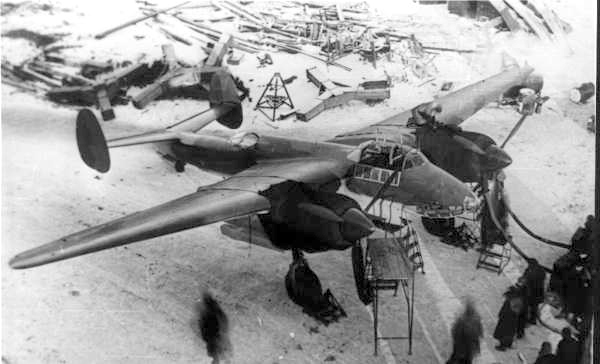
All of the steps involved so far had been thoroughly competent, timely and successful. One of the first three machines can be seen in the photo at the top of this article; it looks ready to go. With the enormity of the Omsk facility behind him, and a fine and successful trio of example machines built at his KB already, Tupolev proceeded to accomplish... absolutely nothing. The same first three machines were at last handed over to the 3rd Air Army for combat evaluation in September 1942, nine months after series manufacture was to have started! Tupolev blamed the evacuation. Under even worse conditions, all of the other senior designers who were evacuated flourished. Within nine months Ilyushin had exploded Il-2 manufacture, solved the wooden wing transition and introduced a two-seat version; Lavochkin had re-worked the dodgy LaG-5 prototypes into a war-winner fighter never matched by the Germans; Yakovlev simply excelled in every direction. Tupolev blamed the M-82 engine; with respect, that is a ridiculous excuse. Tupolev blamed the local staff, who were all "incompetent". Tupolev blamed leading engineer Sokolov. And so on-- it was always someone else's fault. What in fact we can see is that, shorn of his enormous supporting staff, Tupolev was simply not up the job.

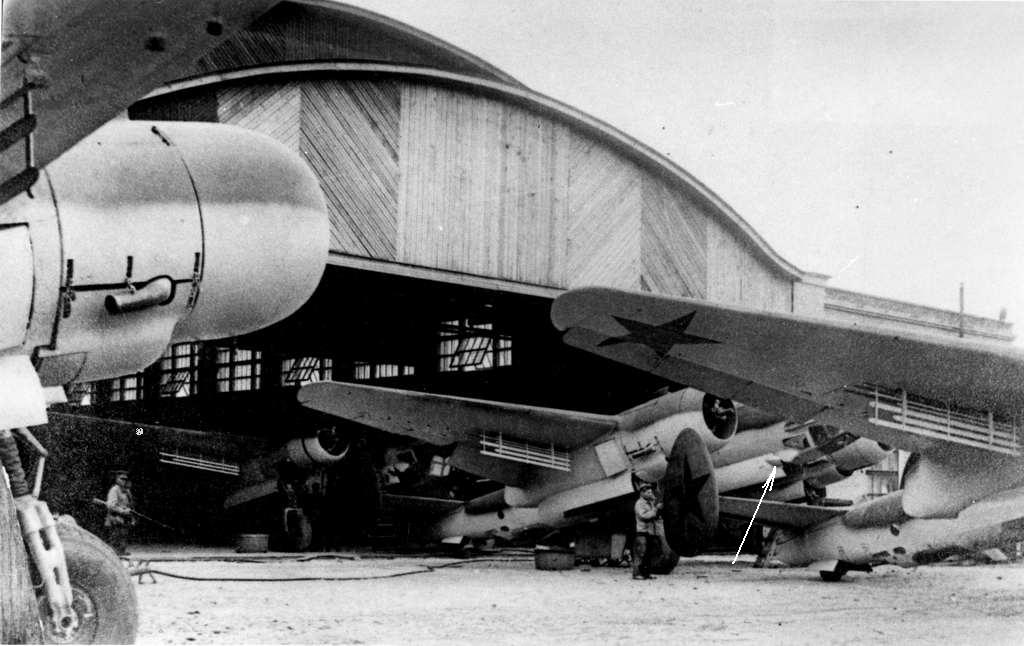
During the course of 1942 exactly 80 examples of the Tu-2 were built. The specific details of these machines are not well documented. A fine image of these aircraft is known and can be seen below.


What seems to be the case is that most of these examples served with the 132 BAP during the first half of 1943. These aircraft were well regarded by flight crew and performed admirably. Word of these machines began to circulate throughout the VVS, and of course in Moscow. However, the failure of Tupolev's Bureau to get anything done annoyed the NKAP, who thus decided in October of that year to transition the KB-1 facility to Yak-9 production, much to the relief of the local staff. Development work continued at Omsk, however, and by 1943 Tupolev's team were working on major internal improvements to the type, and acheived no less than 400 kg of weight savings in the process. Moreover, they were promised the M-82FN engine for future versions, and the ridiculous dive brakes were discarded along with this role; this bode very well. Tupolev's staff made the confusing use of older nomenclature for the revised aircraft ("103V"), muddling its development, but eventually the name Tu-2S began to stick for the improved version, which also later became the ANT-61.

Somewhere in the NKAP, 
someone (it has always been rumoured to have been A.S. Yakovlev, in fact!) realised that the Tu-2 was at last going to fulfil its potential. A semi-disused lot at the Omsk facility was refurbished and made the official home of the Tupolev OKB, eventually as Factory No 156 [5]. The old Moscow-Fili facility, now dormant (Factory No 22 was evacuated to Kazan') was restored for Tu-2S production and named Factory No 23. Offices at Tupolev's earlier TsAGI stomping ground on Radio Street were re-opened and made available for his use. Readers of this article will likely not need reminding that the new machine passed it State Examination with flying colours, and thus was immediately launched into mass production at two factories, and with gusto. Despite Tupolv's unending complaints to the contrary, the author can detect not a single trace of Government interference or prejudice against his OKB here. Moreover, now with a growing staff of very competent professionals under his direction, Tupolev's Bureau began a period of fruitful and important work.

Rejuvenated, Reinvigorated, Reborn

The story of the Tu-4 is well known and told elsewhere, and is outside of the scope of this article. What is intersting to contemplate is that the job of copying the B-29 bomber fell to Tupolev, and not to Ilyushin. These two were the most obvious candidates, and between them it was Tupolev who was the past master of all-metal dural structures (there was no possbility that the USSR could have replicated the sophisticated US aluminium alloys used on the original). The author is convinced that this was the reason for choosing his OKB. Well, that and perhaps another practicality... Stalin assigned the absolute maximum priority to this project. In practice this meant that the head of the OKB could make demands upon the entire indstry if needed (they were), and would get his way. Tupolev in the 1930s was effectively the head of the Soviet aviation industry-- not in name, of course, but in day-to-day reality it was true. During the frantic rush to build the Tu-4, Tupolev again acted instinctively in this manner, and one must admit, very successfully. Tupolev, the Titan of Soviet aviation, was back.

Readers will need no recounting of the Tupolev Bureau's post war successes; they are too many and too great for itemisation here. Tupolev went from strength to strength, but this time employing a new method of working. Starting with the Tu-4 project, Tupolev specifically and openly declared the work and contributions of junior staff. Other designers were given credit for OKB creations and projects, not him personally. It is fascinating to contemplate the origin of this major change of course-- was Tupolev looking for plausible deniability of responsibility if some project went wrong (especially from Stalin), or had he learned a lesson during the problematic times at Omsk? Who can know? Whatever the case, a golden era descended upon his fortunes and his OKB, and certainly this must be put down in part to Tupolev's acceptance of his role as an industrial leader, not a faultless aviation theoretician.


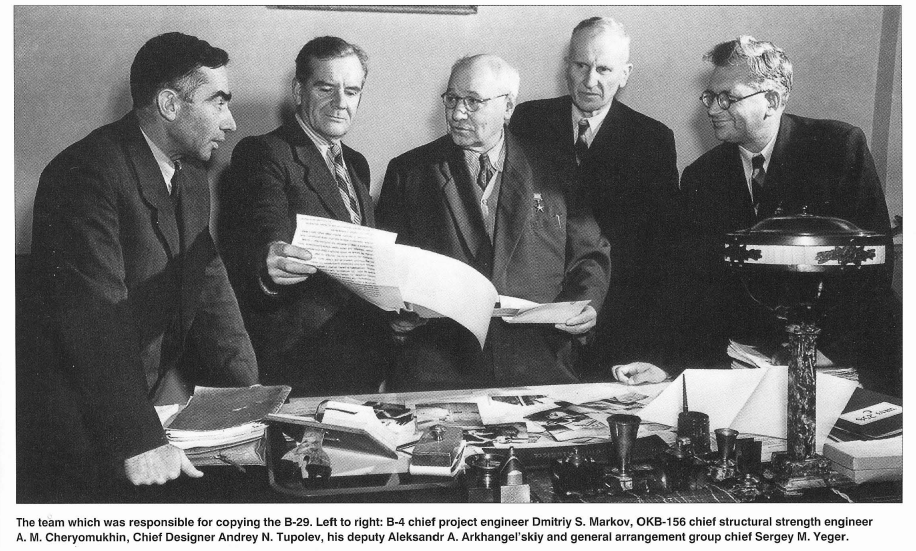
Have a look at this photo and the caption from Midland Pubs Tu-4 Soviet Superfortress (Gordon, Rigmant), page 15. Could anyone imagine such an image from the 1930s!? No possible chance...

What Was the "Tu-2 Problem"?

The main point of this article: how can we explain the unprecedented delay with this remarkable design? Some in the Government (and elsewhere) maintain that Tupolev was deliberately dragging his feet. It was a kind of mild sabotage-- sour grapes from the man for having been arrested. Well, such a claim is plausible, certainly. Tupolev was arrogant enough to have resented virtually any slight, so to have been denied his comfy flat and social life in Moscow for two years would certainly fit that bill. On the other hand, such a strategy was risky to say the least, and really to accuse the man of treachery during a war of national survival? It's very harsh, and to the author it doesn't ring true. There have been claims by Tupolev and those around him that he was the victim of directed sabotage by the Omsk staff and other insidious persons in the industry. The author has no doubt that Tupolev was disliked in many places-- and for good reason-- but surely in that time and place had there been a plot against the man it would have succeeded. Tupolev was just only out of trouble; any kind of dedicated smear campaign would have seen him arrested again.

Was the Tu-2 design overly complicated, resulting in unavoidable delays? This idea merits some serious contemplation. When the early production models were subject to some proper re-evaluation at Omsk, the local team managed to reduce the weight by 400 kg without any effect on structural strength. That is a heck of a lot. It is very hard not to be impressed by the 103 prototypes because they look very much the part. Aerodynamically, this was a definite winner and one could tell that 'by eye'. But, did such a pleasing form hide what was in fact an internal pig sty? The aircraft, let us not forget, was designed by a large group of pretty serious engineers confined in space, uncomfortable in situation and likely in some degree of competition with each other. How many chefs spoil the broth? Do we recall what happened with the LaGG's design-by-committee approach? A definitive answer to these questions would require a surviving early Tu-2, and there isn't one, but surely the possibilities suggested by this line of thought must be kept in mind.

Was the Tu-2 not really a priority for the NKAP, and no one dared to tell Tupolev? The Tu-2 was meant to replace the SB and Ar-2 both, and so too was the contemporary Pe-2. Despite early teething troubles, the Pe-2 was doing the job successfully and improving constantly. When Petlyakov-- Tupolev's long time understudy-- was tragically killed in the beginning of 1942, why not send Tupolev to Kazan' to carry on in his stead? Further, it has been noted that the wartime Soviet industry really did not have multiple examples of similar aircraft designs except in fighter aviation. Why, therefore, both the Pe-2 and Tu-2 together? With regard to this domination of a single successful type in one genre or another, the answer is a bit of mix between design and efficiency. The aviation industry benefited from having competing designs, but the war effort benefited more from sheer numbers. In their efforts to balance these concerns, the NKAP in hindsight can be said to have leaned towards quantity a bit, but always to a degree which was logically justifiable. Having something which is not quite as good as another but immediately available and in bigger quantities is preferable in wartime. But, this slight bias was not entirely their intention at the time. Several Sukhoi designs nearly joined the Il-2 in the attack role, but there always just this one little detail in the way. The Er-2 project did not turn out in the end as hoped-- a supplement to the Il-4-- but this was not for lack of support by the NKAP.

Was there room for both the Tu-2 and Pe-2 in the VVS? The author thinks so, absolutely yes. During the mid-war period (1942-43) the service was crying out for more Pe-2s, and having Tupolevs there alongside them would have been a tremendous help. Later Tu-2s with the M-82FN might very well have supplanted the Pe-2 in 1944, taking over its factories as well, and that would have been quite successful. It seems likely that this is exactly what the NKAP had in mind, but alas the Tu-2 programme simply went nowhere during 1942. When at last the type was deemed ready, the Government threw considerable resources and priority behind the Tu-2, and they were rewarded for it. The author can see no basis for claims that the type fell victim to NKAP priorities.

Conclusions

At first a caution-- the author is no biographer and never has been. Any sort of theories presented here must be seen as falling within the scope of rank amateurism. That said, what is the most likely answer to this obviously complex matter?

Disasters very rarely arise from simple failures. Usually one sees a series of smaller or larger points of failure coalescing in greater or lesser part into the final picture. The author believes that this is what happened with the Tu-2 programme. When Tupolev was sent to Omsk he had been stripped of his enormous and talented supporting staff for the first time, and basically he was found out. The man was no aerodynamicist-- he was a materials and structural engineer. But Tupolev had been around since the very beginning of aviation when, in its infancy, there wasn't a lot to choose between the two. Thus, a myth was allowed to grow around Tupolev-- mostly caused by his arrogant taking of credit for other's work-- in which he has seen as a great designer of aeroplanes. He wasn't. The task with the early Tu-2 was to refine the design as an aircraft, a job which was over his head and outside of his areas of speciality. Moreover, the Tu-2 was a complex beast, as proven by later work. Without a supporting team of designers who did excel in this respect, development stalled. Indeed, without such promising prototypes, it would have failed. One can only imagine what the consequences might have been in that case.

There were many exacerbating elements to this problem, to be sure. One can understand perfectly well that Tupolev was not in the best frame of mind just then. He was happy and comfortable in Moscow, then shipped out to remote and 'uncivilised' Omsk. It took an eternity for Tupolev to start assembling a team again (nine months, or more), and in a place like the Omsk complex that is pretty lamentable. He was floundering, desperate, demoted and one suspects, a bit under the microscope. With that kind of ego no doubt he lashed out at everyone and everything around; of course he could not be the cause of these delays. The pattern in behaviour all too recognisable, and his personal accounting of this episode basically confirms the allegation. So, was this sabotage? The author does not accept that suggestion. He did not chose to act in such a foolish way; like any of us, he was the victim of his own inner daemons. No doubt he was not conciously aware of his own behaviour, and would not have approved of it had he been.

The author would like to think that Tupolev, the man, learned his lessons in the dark days of 1942-43 at Omsk. There is good evidence for this assertion, as well. By the end of the war Tupolev had seemingly regained his former confidence and stature. The Tu-2S was brilliant and everyone knew it. His OKB was working very well, and Tupolev was spending large amounts of time in Moscow again, enjoying city comforts. Gone was his habit of taking credit for the efforts of his team, and morale at all of his related offices and facilities evidenced this. His interactions with the aviation industry and the new Ministry (MAP) were as sound as ever, and his handling of Stalin was competent (no doubt despite considerable worries). The programme to crash develop the Tu-4 was a big risk and Tupolev handled it excellently, and moreover, very successfully. In the author's eyes, Tupolev had regained his comfort zone and rightful place as a great captain of industry, but perhaps this time around without the Tupolev Mythology hanging around the man's neck like a mill stone. History has recorded the benefits of that happy marriage of circumstances-- no further comments on the matter are needed.


A Little Addendum

During the research for and creation of this article I was asked on many occasions for my opinion on Ken Duffy's 1996 classic, Tupolev the Man and His Aircraft. I did of course read it; no, I don't necessarily agree with all of it. And that is perfectly fine. I think one has to look at the timing of this work. I believe that what Mr Duffy was trying to do was entirely laudable, that is to spread the message that the late USSR had a tremendous aviation history and produced many great men and women. Western hate idiocy during the Cold War had consigned all activity in the country to the rubbish bin, and this was (and is, still true now) a farcical injustice. To me, he was trying to rectify that view to some degree. By his own admission he was no expert on the subject, and so in that position it is not very hard to be misled.

Much of the work was completed by Tupolev's long-time friend and lieutenant, Andrei Kandalov, and relying a bit on his son, Valentine Tupolev-- Director General of the Tupolev company-- and similar such parties. These are hardly the places to look for objective details of the man's life! And so, of course, the book does read like a Tupolev fan booklet; it would in those circumstances, wouldn't it? That is no statement of disrespect to Mr Duffy, by any means, and I think his work on the topic was meaningful and at the time remarkable. Have do doubts either that he will have suffered a fair amount of abuse, scorn and dereliction of his reputation for having written it. So, hats off from me.

Lastly, I just cannot understand why so many want to make myths out of real people. To what end? Tupolev was a huge figure in aviation globally; what more could be needed than that? Isn't that enough for one real lifetime? In my own opinion, treating anyone in this way is outright mockery and it must stop. Indeed, this pathetic behaviour tells us a lot about our society and nothing about the intended subjects.  
Senatores, sed audiemus?

----------------------------

1. Bear in mind that Soviet aviation nomenclature did not include the name of the designer until 1941. Aircraft were designated by their function, often during design development as well. But not in the case of Tupolev; anything designed by anyone under his directorship invariably received his personal name.
2. TsAGI began to fragment as it grew in size and competence. AGOS was to deal with physical matters, such as structures, alloys and flight testing, while the main body of the organisation retained their remit for theoretical and aerodynamical study.
3. It is perhaps difficult to convey the shock of this practice to the average Westerner. Soviet society was supposed to be egalitarian; not even Iosef Stalin had a private parking space with his name it! But Tupolev did.
4. It reminds the author entirely of A. Solzhenitsyn and his voluminous testimonies of the gritty detail of daily torture and hardship in the "gulags", which was completely debunked following his death. His arrest papers were found in the SMERSH archives, not the NKVD, which also subsequently proved that he did not spend a single hour in any GULAG camp, but rather in the Internally Displaced Citizen programme.
5. There is disagreement between various learned researchers on whether Tupolev's OKB at Omsk was called Factory No 156 during the war. After it, certainly, as part of the post war reorganisation under the new MAP. But, documents from the war period appear only to mention Factory No 166 at Omsk, albeit this was the over-arching name of a vast complex.