An
article describing the Borovkov-Florov I-207 appeared on the late VVS
web site some 5 years ago. However, following a serious re-examination
of this aircraft and its details, I decided that I was not at all
satisfied with our existing drawings of the No4 prototype, and neither
with the details of its gear operation as presented. Therefore, let is
now look to an updated interpretation of this machine and its features,
including all new line drawings and profile.
The I-207
The Borovkov-Florov I-207 family of
prototype fighters derived from the experimental 1937 'aircraft
(Factory) No. 7211'. This advanced biplane design was the creation of
senior Polikarpov OKB designers A.A. Borovkov and I.F. Florov, and its
history and development have been admirably covered by Mikhail Maslov
in M-Hobby magazine (issue #42). A summation of Maslov's description may be found here.
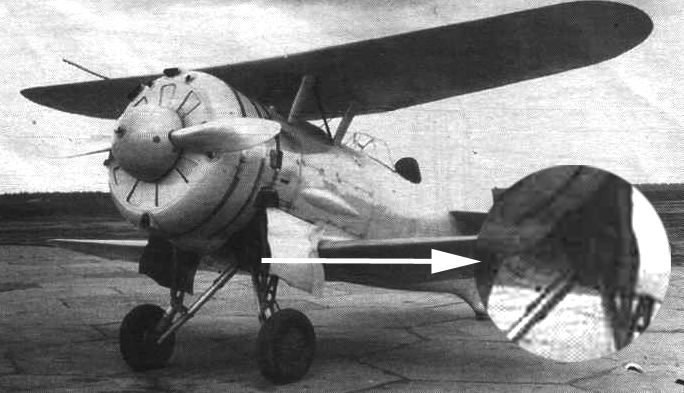
The I-207 No.4 prototype (also written as "I-207/4") in particular has
caught the eye. Not only, of course, for the nice streamlining of the
machine, but also for the curious technical features to be seen on the
aircraft-- dural skinned all-metal wings with no inter-plane struts, shpon fuselage
skinning, moveable rear fairing with integrated tail-wheel, and so on.
However, the No.4 is also the least well known of the I-207 family, and
photographs of this prototype are not common.
It is likely for this reason that drawings of the No.4 prototype
were not, ultimately, entirely satisfactory. Following a conversion
about this aircraft and its gear-- and the possibility to recreate
these for a scale R/C model-- it became clear that the various
geometries of the existing drawings did not, and could not, work.
Therefore, these drawings-- as well as my own-- must be inaccurate. The
need for a thorough re-think became obvious.
Retractable Landing Gear
A close look at the I-207/4's main landing gear suggests that these
units may be
identical to those mounted on the No.3. There are no known photographs
showing the internal operation of the No.3's gear which would permit us
to be certain. Be that as it may, without doubt the gear units are
similar, albeit the method of enclosing them in the fuselage with
various panels is not.
The influence
of the designers' Polikarpov OKB background is seen throughout the
I-207, and certainly with respect to the landing gear, as the
retractable unit reminiscent to that seen on the I-153, for example,
and in
mechanical operation it is clearly related.
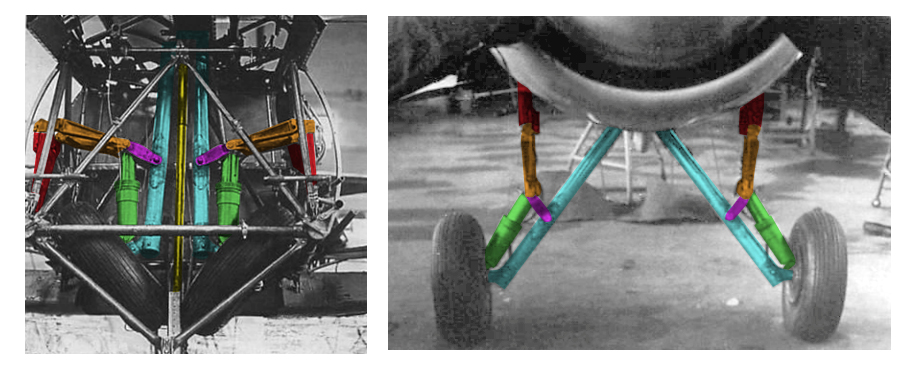
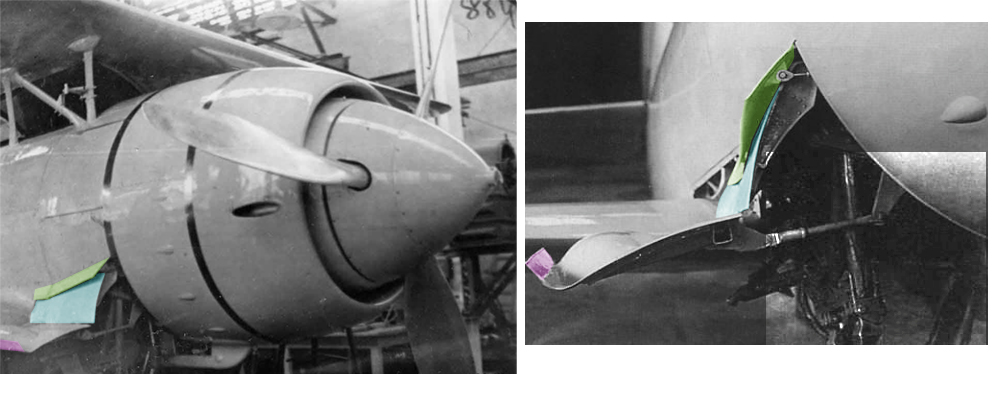
The image above left has been
labelled as the No.3 prototype's gear (retracted). I am convinced,
however, that this is fact a photograph of the No.4 prototype. The
tyres are seen resting against a keel which runs through the bay, as on
the I-207/4. No such feature is shown on the I-207/3 (see below).
Moreover, the upper decking is asymmetrical as would be required for
the No.4's revised armament, and this also does not agree with the
No.3's quartet of ShKAS. The same gear pieces are shown in their
extended position upper right (with cowling fitted).
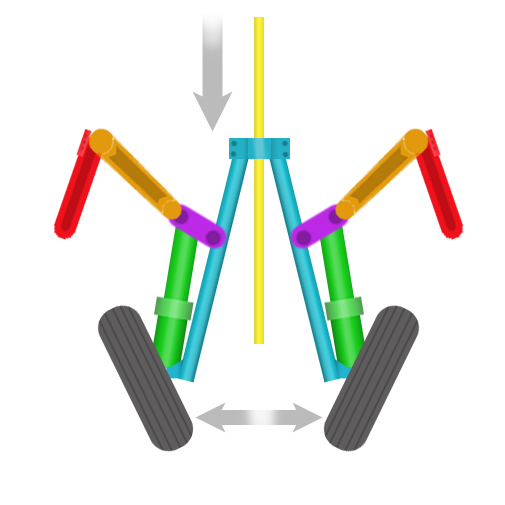
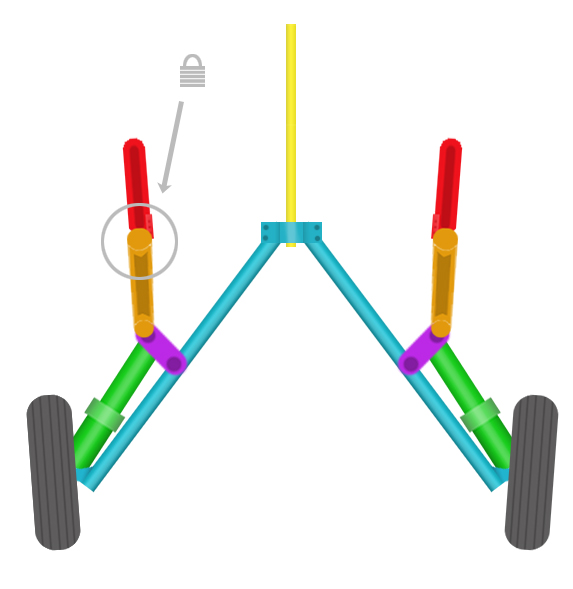
The various
components of the gear system are highlighted in the same colour in
each image, showing their respective position and deployment. When
retracted, the main gear struts [blue] slide upwards and inwards along
a central strut [yellow], dragging the tyres and the oleo units [green]
with them. Forked crutches [red and orange] pivot and fold with the
movement, attaching via a smaller clamp [purple].
As the gear is extended, the main struts slide downwards. This
action forces the tyres to splay outwards, but keeping the oleo units
in the same relative position. The mounting forks on each side
unfold in the process.
Once the gear is fully extended, the tyres have moved through to
about 85 degrees (or so). The gear is locked in the downward position
by latch pins at the joint between the two main crutches. Gear
retraction simply involves a reversal of the same process.
Gear retraction in the I-207/4 (and /3) was manual, operated by a
hand-crank in the cockpit in the same manner as other contemporary
Polikarpov designs such as the I-153 and I-16.
Gear Doors and Covers
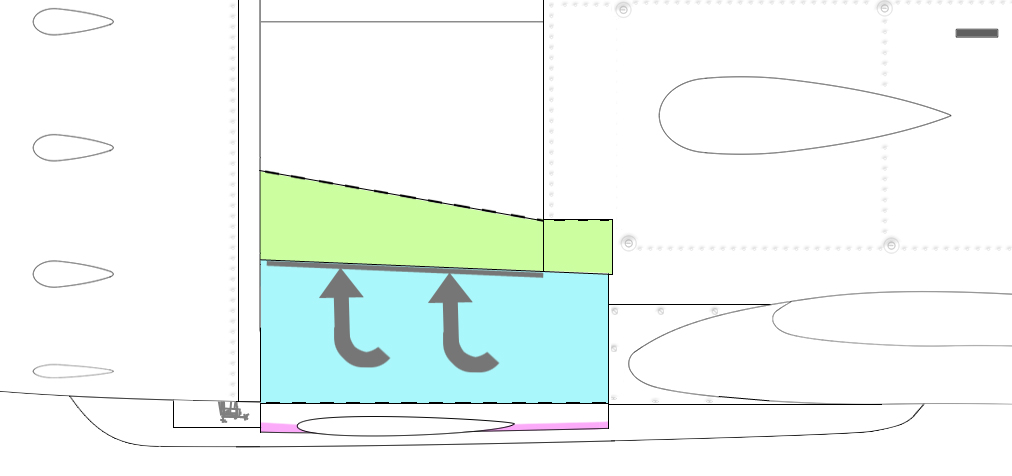
The arrangement of the various gear doors and covers on the No.4
prototype are unique, completely different from the method used on the
No.3. The I-207/4 employes a more streamlined bay section in which
hinged covers both pivot and twist to close the bay, which itself is
reinforced by a keel running aft from the lower wing main spar to the
cowling.
When the gear is extended, the upper gear cover [green] pivots
outwards on its hinge, twisting towards the front of the unit where a
small rod can be seen to push it outwards. The middle cover [blue]
slides upwards, underneath the
upper cover. The lower cover piece [pink] has a strip along its bottom
edge which rests against the keel, thus helping to form an aerodynamic
closure.
The Results of Re-evaluation
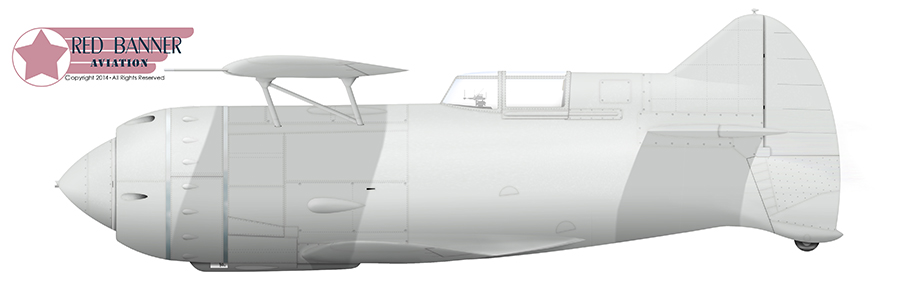
After a thorough review, not only of the gear but of all aspects of the No.4 prototype, here is a revised profile of the aircraft.
coming in Part II: The I-207 Family Development and Features