| Official Bomb & Armament Guide: IL-2 |
In the
midst of recent work regarding the Il-2 and research developments, I
was suddenly deluged by requests for information regarding VVS aircraft
bomb and arming schematics during the GPW. Perhaps these requests were
inspired by the recent P&S title on the Pe-2, but whatever the case
(or grand conspiracy!) I felt that a small break to investigate these
matters might be in order. Fittingly, given recent efforts, we will
therefore start this new series of articles with the Ilyushin Il-2.
=============================================
Official Arming Documents
So
far as the official arming and bomb loading diagrams for the Il-2 are
concerned, the author here can draw from three main documents. Firstly,
we have the Armament section of the 1941 Tekhnicheskoe Opisane [roughly pages 10-85]. Next, a separate Tekhnicheskoe Opisane from 1943 exclusively on Il-2 Armament. Lastly, a 1942 document titled On the Employment of Il-2 Armament.
These can be embellished by other sources, such as the 1947 Czech
Manual on Il-2 Armament, and a general 1945 guide to VVS Ground
Attack Operations.
These materials are, of course, quite outstanding. But, we must also
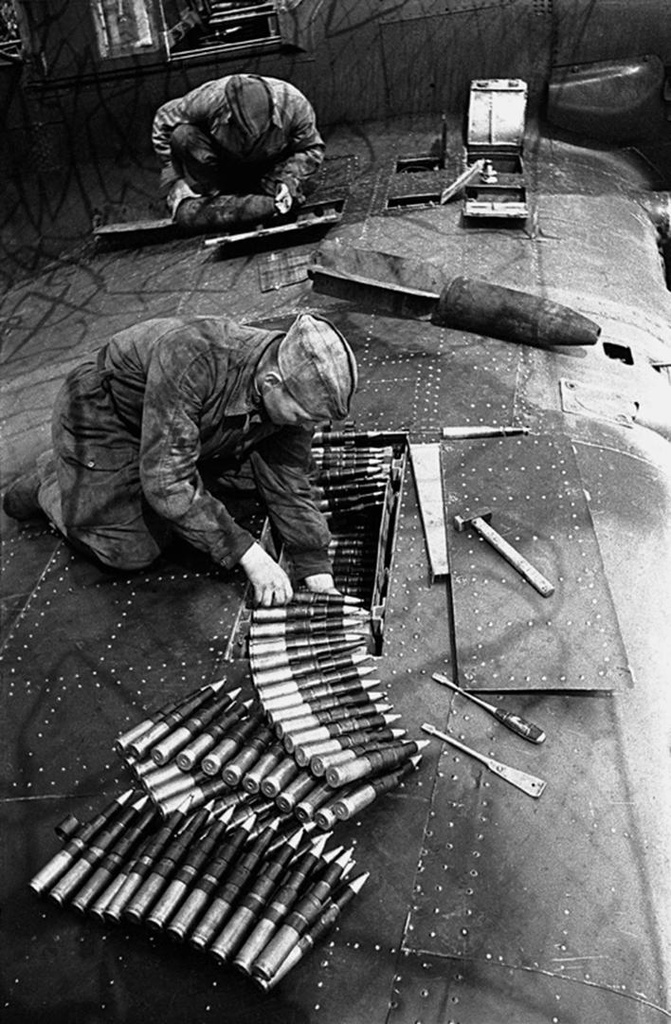
pay close attention to one more large body of data, that being the photographic record. The documents and manuals tell us what should have been done, but only the latter can reveal what actually was done, which is, after all, what we wish to know.
What is also fascinating are the occasional incongruities
between the various sources. As the Il-2 changed, the resulting
technical documentation would also have to do so to reflect this fact.
But, a Tekhnicheskoe Opisane
(T.O.) was also required to be relevant to older models still in
service, as well. One can see that these manuals tried to preserve
whatever they could from earlier additions, and in cases this lead to a
small degree of confusion. For example, the 1943 T.O. gives the rocket
armament as four missiles-- either RS-82 or RS-132-- but the
accompanying diagram shows eight launch rails (as per earlier models),
and mentions the RO82 rail which, from the photographic record and
other written sources, we know was no longer in use on the Il-2.
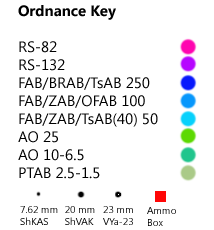
Bomb Graphics Key
The following illustrations show various load-outs using the following graphics key.
Technical Specifications
The Il-2 was equipped with four internal bomb bays. These bays
were contained within the wing centre-section, and spanned the full
space between the front and aft spar. The bottom doors were simply
spring-loaded; there was no opening/closing mechanism. Bombs were fixed
into these bays using the DER-21 bomb rack/hanger mechanism, for which
a significant number of internal mounting points were provided.
External stores were mounted on a MDZ-40 (earlier) or DER-31 (later)
rack/hanger device mounted on the bottom of the spar separating the two
bays. The bomb bay doors could open if the externals bomb was a 50 kg
weapon or smaller, but if a 100 kg munition (or larger) was mounted it
had to be salvoed first before the use of any internally carried bombs.
In the early Il-2 models, eight RO82 rocket rails were mounted under
the outer wing panel. These units were attached to the bottom of spars
#9, 10, 11, 12, both wings. During 1942 the use of the smaller RO82
rail was discontinued and replaced by the RO132 rail, which could
accommodate both the original RS-82 and also the larger RS-132 rocket
[and also Army M-8 and M-13 rockets; see below]. Four RO132 rails were
carried, these attached to spars #9 and 11. From 1944, all factories
were installing RO132 rails with a full fairing, thus improving
streamlining.
The fixed armament consisted of two 7.62 mm ShKAS guns with 750 rounds
of ammunition each in the inner position. These were supplemented by
two cannon in the outer position, either 2 x 20 mm ShVAK (early models)
with 250 rounds each, or more usually 2 x 23 mm VYa-23 with 150 rounds
each. In the two-seat models, a defensive 12.7 mm UBT gun was installed
in the aft cockpit with 150 rounds.
Normal Loading
The T.O. gives the Normal (or Standard) loading for the Il-2 as four
fixed guns (2 x ShKAS and either a ShVAK or VYa-23), a defensive UBT
(if applicable), four or eight rockets under the wings (as per the Il-2
model in question) and 300 kg of bombs internally and externally (if desired). Note that it was absolutely acceptable to mix-n-match different stores
in
any of the four bomb bays up to the maximum permissible weight of the bombs
carried, but the various documents did in cases show or describe a
typical outfit.
The 1942 document gives the following configuration as an example of a Normal Load-Out.
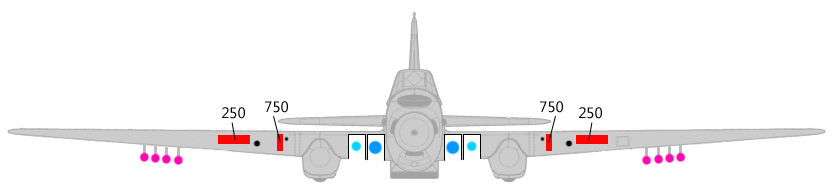 2x100+2x50=300
...or with external bombs.
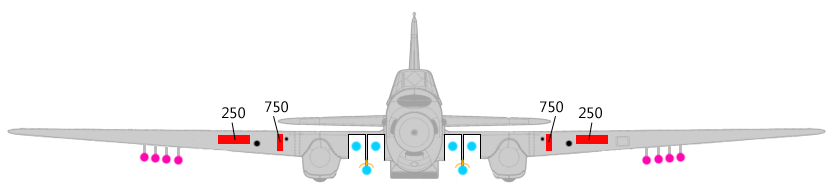 6x50=300
Maximum Load ('Overloaded' Condition)
The maximum permissible bomb load, which is referred to as 'Overload', is listed in the T.O. as up to 600 kg. The suggestion for this arrangement in the 1941 document is as follows.
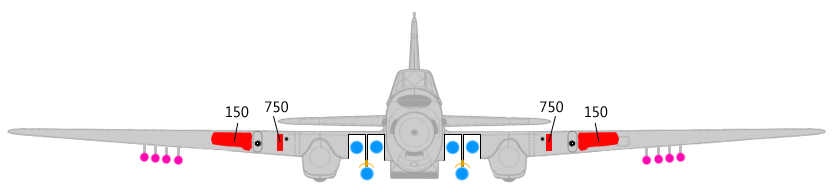 6x100=600
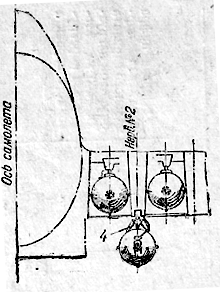 The 1941 T.O.'s diagram of this load-out.
The external hangers could accommodate a weapon of up to 250 kg weight,
but in the case of using such munitions it was recommended not to use any internal bomb storage.
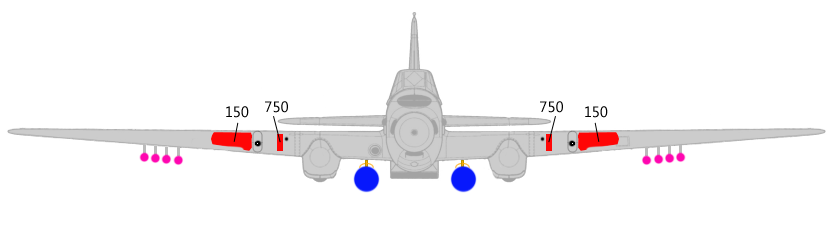 2x250=500
Likewise, some load-out suggestions were given by role; e.g. the purpose of the mission. These were commonly seen in the earlier documentation (1941, 1942). The following scheme, for example, was suggested for the scout-reconnaissance role.
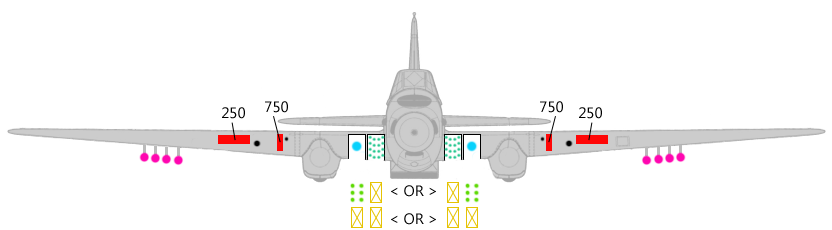 48x6.5 (two banks each) + 100=412, 12x25 + cassette, 4 x cassette
Whereas, the 1945 ground attack document suggests the following for 'tank hunting' sorties.
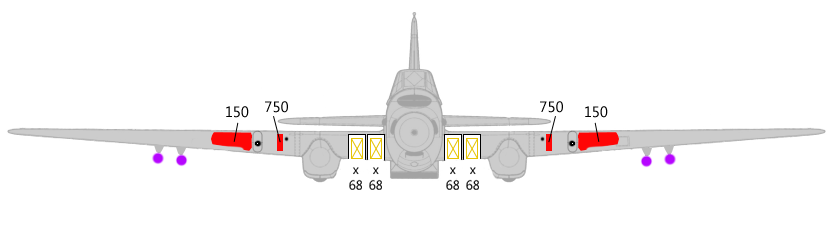 272 x PTAB 2.5-1.5
Small Calibre Bombs and Cassettes
The usual bomb cassette in use was the KMB type, often the KMB-2. This
box-like device was loaded with smaller bombs or sub-munitions which
were 'dumped' simultaneously, rather than by salvo. Bombs as small as
6.5 kg (e.g. the AO 10-6.5) could be mounted on DER-2 hangers
individually, but as one might imagine that would involve rigging a
very large number of fuses and DER-2s, and few ground crew would relish such tedium.
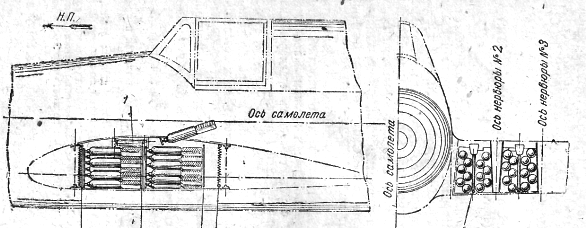
The scheme for mounting 96 AO 10-6.5 bombs in the internal bay with
DER-2 hangers (in two banks each). Armourers must have been gravely
tempted to rip this page from the T.O. and 'accidentally lose' it
somewhere...
More commonly, such small munitions were instead packed into a KMB
cannister. The loading tables for 1941 and 1943 (and PTABs in the 1945
document) give the following totals:
AO 2.5 = 36 / cannister
ZAB 2.5 = 30 / cannister
AO 8 = 10 / cannister
AO 10-6.5 = 32 / cannister
AO 10 = 8-10 / cannister
AO 15 = 6 / cannister
AO 25 = 4 / cannister
AZh-2 ampoule = 54 / cannister
PTAB 2.5-1.5 = 68 / cannister
PTAB 10-2.5 = 36 / cannister
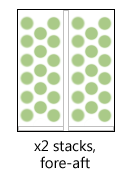 The loading arrangement for the PTAB 2.5-1.5 in the KMB cassette (68 total).
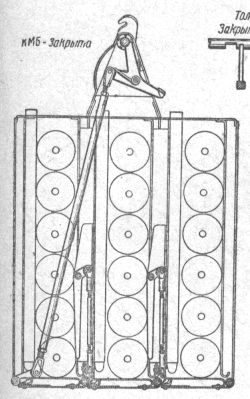 The loading arrangement for the PTAB 10-2.5 in the KMB cassette (36 total)
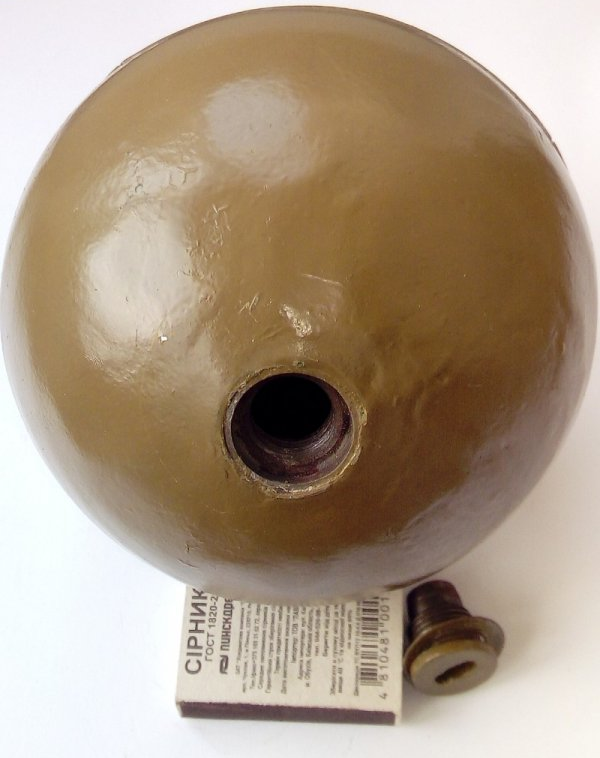 The AZh-2 ampoule, basically a steel ball spewing a phosphorous mixture as it rolled/tumbled along the ground.
Other External Stores
In addition to 250 kg calibre bombs, the Il-2 could also carry various
other weapons or devices on its external mounting hardware. These
included the chemical dispensers UKhAP-250 and VAP-250, and later in
the war the RRAB-250 sub-munitions dispensing cannister.
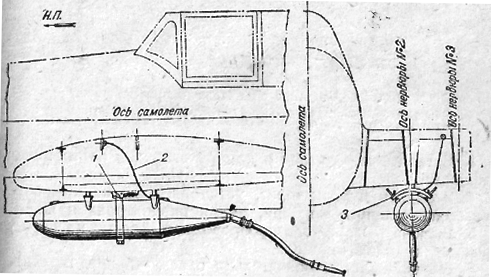 The UKhAP-250, from the T.O.
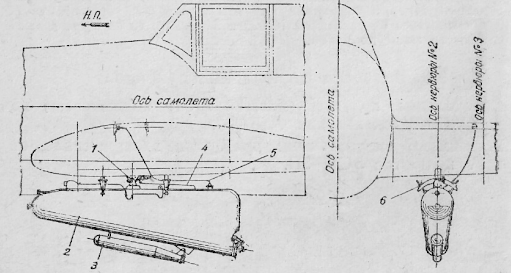 The VAP-250, from the T.O.
The photographic record also reveals that many Il-2s did use the Army M-8 (82 mm) and especially the M-13 (132 mm) rockets in lieu of the RS-82 and RS-132. 'M' rockets were designed for use with the Katyusha
system and were derivatives of the RS, but featuring more propellant
charge which was more tightly packed into the missile body. As a
result, these units had more thrust and greater range, but also of
course (for the same reason) hotter exhaust gasses, which the NII VVS
and NIPAV worried might damage the wing's under-surfaces. As a result,
the RS rocket was officially proscribed for aviation use-- and M
rockets never appeared in any official documentation-- but, despite
this fact, photographs of M rockets loaded onto the Il-2 are
commonplace and clearly were employed in action despite their
'unofficial' status.
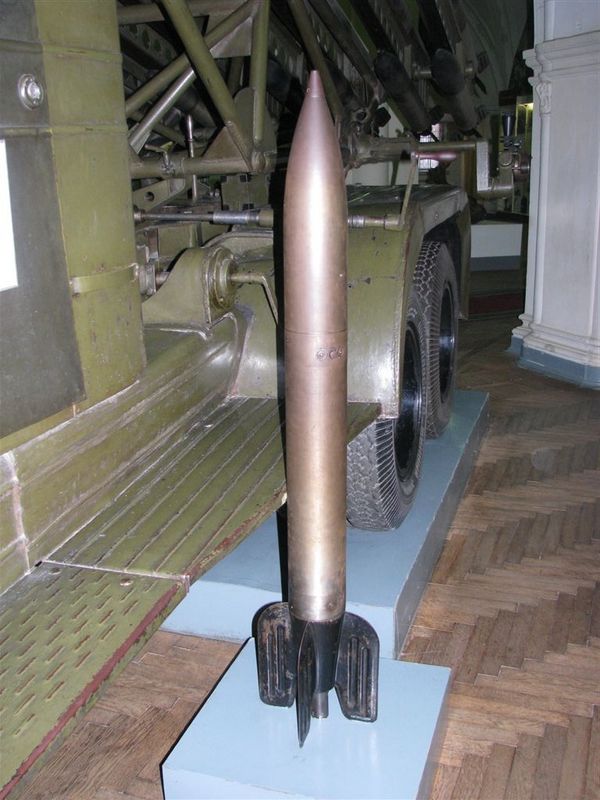 M-13 rocket.
---------------------------